
|
You entered: telescope
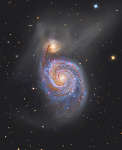 M51: The Whirlpool Galaxy
2.06.2012
Follow the handle of the Big Dipper away from the dipper's bowl until you get to the handle's last bright star. Then, just slide your telescope a little south and west and you might find this stunning pair of interacting galaxies, the 51st entry in Charles Messier famous catalog.
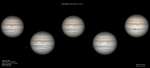 Jupiter and Io
28.11.2012
On December 3 (UT), Jupiter, the solar system's largest planet, will be at opposition, opposite the Sun in planet Earth's sky, shining brightly and rising as the Sun sets. That configuration results in Jupiter's almost annual closest approach to planet Earth.
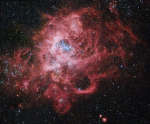 NGC 604: Giant Stellar Nursery
11.12.2012
Stars are sometimes born in the midst of chaos. About 3 million years ago in the nearby galaxy M33, a large cloud of gas spawned dense internal knots which gravitationally collapsed to form stars. NGC 604 was so large, however, it could form enough stars to make a globular cluster.
 APOD: 2025 September 4 Б NGC 4565: Galaxy on Edge
4.09.2025
Magnificent spiral galaxy NGC 4565 is viewed edge-on from planet Earth. Also known as the Needle Galaxy for its narrow profile, bright NGC 4565 is a stop on many telescopic tours of the northern sky, in the faint but well-groomed constellation Coma Berenices.
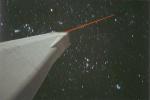 Space Laser Creates Artificial Star
25.04.2001
Some astronomers don't like stars. Bright star fluctuations can indicate how the Earth's atmosphere is changing, but many times no bright star exists in the direction where atmospheric information is needed.
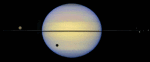 Saturn's Rings Seen Sideways
29.04.1996
Saturn's rings are actually very thin. This picture from the Hubble Space Telescope was taken on August 6, 1995 when the rings lined up sideways as seen from Earth. Saturn's largest moon Titan is seen on the left, and Titan's shadow can be seen on Saturn's cloud tops!
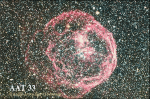 Henize 70: A SuperBubble In The LMC
10.05.1996
Massive stars (tens of times the mass of the Sun) profoundly affect their galactic environment. Churning and mixing the clouds of gas and dust between the stars, they leave their mark in the compositions and locations of future generations of stars and star systems.
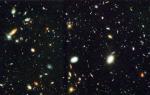 The Hubble Deep Field
1.09.2002
Galaxies like colorful pieces of candy fill the Hubble Deep Field - one of humanity's most distant optical views of the Universe. The dimmest, some as faint as 30th magnitude (about four billion times...
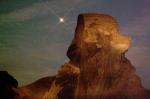 Mars Rising Behind Poodle Rock
13.08.2003
Have you seen Mars lately? As Earth and Mars near their closest approach in nearly 60,000 years on August 27, the red planet has begun to appear dramatically bright and show interesting details through telescopes and binoculars. Although not yet visible at sunset, Mars can be seen rising increasingly earlier in the evening.
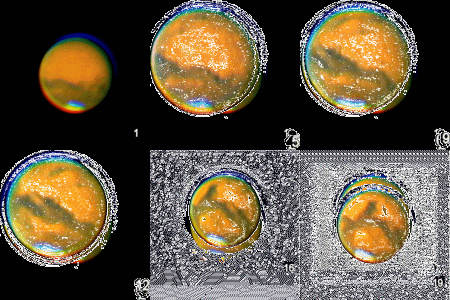 Earth Webcam Catches Mars Rotation
26.08.2003
Mars won't look this good. Tonight and over the next few days, when Mars is at its closest approach to Earth in nearly 60,000 years, you might get your best view ever of our planetary neighbor.
|
January February March April May |
|||||||||||||||||||||||||||||||||||||||||||||||||