
|
You entered: telescope
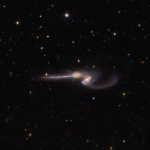 NGC 4676: The Mighty Mice
14.06.2019
These two mighty galaxies are pulling each other apart. Known as The Mice because they have such long tails, each large spiral galaxy has actually passed through the other. Their long tails are drawn out by strong gravitational tides rather than collisions of their individual stars.
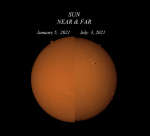 Perihelion to Aphelion
8.07.2021
Aphelion for 2021 occurred on July 5th. That's the point in Earth's elliptical orbit when it is farthest from the Sun. Of course, the distance from the Sun doesn't determine the seasons.
 APOD: 2025 August 7 Б The Double Cluster in Perseus
7.08.2025
This stunning starfield spans about three full moons (1.5 degrees) across the heroic northern constellation of Perseus. It holds the famous pair of open star clusters, h and Chi Persei. Also cataloged...
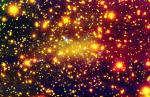 Cepheus 1: Nearby Galaxy Hiding
1.12.1998
Some galaxies are hard to find. Besides being hidden behind the dust and bright foreground stars of our Milky Way Galaxy, recently discovered Cepheus 1 was missed previously because it is so uniformly dim.
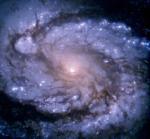 M100: A Grand Design
3.02.2001
Majestic on a truly cosmic scale, M100 is appropriately known as a Grand Design spiral galaxy. A large galaxy of over 100 billion or so stars with well defined spiral arms, it is similar to our own Milky Way.
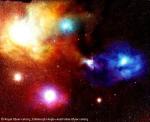 Antares and Rho Ophiuchi
22.09.1997
Why is the sky near Antares and Rho Ophiuchi so colorful? The colors result from a mixture of objects and processes. Fine dust illuminated from the front by starlight produces blue reflection nebulae. Gaseous clouds whose atoms are excited by ultraviolet starlight produce reddish emission nebulae. Backlit dust clouds block starlight and so appear dark.
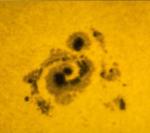 Spiral Sunspot
4.02.1999
Spiral galaxies abound in the universe, but spiral sunspots are definitely an unusual twist. This distinctive spiral-shaped sunspot caught the attention of National Solar Observatory astronomers and was photographed on February 19, 1982 with the Vacuum Solar Telescope on Kitt Peak.
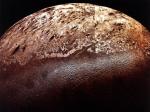 Triton: Neptunes Largest Moon
4.03.2007
In October of 1846, William Lassell was observing the newly discovered planet Neptune. He was attempting to confirm his observation, made just the previous week, that Neptune had a ring. But this time he discovered that Neptune had a satellite as well.
 NGC 7814: Little Sombrero
23.01.2025
Point your telescope toward the high flying constellation Pegasus and you can find this cosmic expanse of Milky Way stars and distant galaxies. NGC 7814 is centered in the sharp field of view that would almost be covered by a full moon.
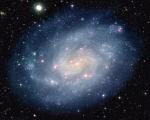 Spiral Galaxy NGC 300
21.08.2002
NGC 300 is so interesting because it is so normal. An Sc-type spiral galaxy in the nearby Sculptor group of galaxies, NGC 300 shows typical flowing blue spiral arms, an expected compact nucleus, and the requisite amount of stars, star clusters, and nebulae.
|
January February March April May |
|||||||||||||||||||||||||||||||||||||||||||||||||