
|
You entered: telescope
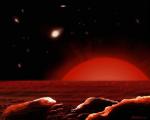 Stars Without Galaxies
19.01.2002
Galaxies are made up of stars, but are all stars found within galaxies? Using the Hubble Space Telescope, researchers exploring the Virgo Cluster of galaxies have found about 600 red giant stars adrift in intergalactic space. Above is an artist's vision of the sky from a hypothetical planet of such a lonely sun.
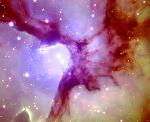 In the Center of the Trifid Nebula
26.06.2002
Clouds of glowing gas mingle with lanes of dark dust in the Trifid Nebula, a star forming region toward the constellation of Sagittarius. In the center, the three huge dark dust lanes that give the Trifid its name all come together.
 A Star Forming Region in the LMC
25.06.1996
Stars sometimes form in colorful ways. Pictured above is a small region in the nearby LMC galaxy where stars are forming. After a star is born, it may do several things to energize its immediate neighborhood.
 A Quasar in the Gamma Ray Sky
17.11.1996
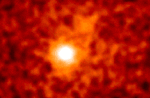
The bright object in the center of the false color image above is quasar 3C279 viewed in gamma-rays, photons with more than 40 million times the energy of visible light. Like all quasars, 3C279 is a nondescript, faint, starlike object in the visible sky.
 A Wolf-Rayet Star Blows Bubbles
3.01.1997
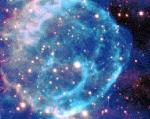
Wolf-Rayet stars can blow bubbles. These unusual stars are much hotter and more luminous than our Sun. All extremely massive stars will eventually evolve though a Wolf-Rayet phase. Approximately 200 Wolf-Rayet stars are known in our Milky Way Galaxy. Wolf-Rayet stars generate bubbles because they continually eject their outer atmosphere as a stellar wind.
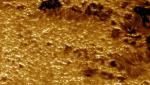 The Suns Surface in 3D
24.06.2003
How smooth is the Sun? The new Swedish 1-m Solar Telescope, deployed in the Canary Islands only last year, allows imaging of objects less than 100-km across on the Sun's surface. When pointed toward the Sun's edge, surface objects now begin to block each other, indicating true three-dimensional information.
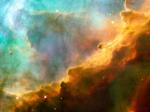 APOD: 2004 August 28- M17: A Hubble Close-Up
28.08.2004
Sculpted by stellar winds and radiation, these fantastic, undulating shapes lie within the stellar nursery known as M17, the Omega Nebula, some 5,500 light-years away in the nebula-rich constellation Sagittarius. The lumpy features...
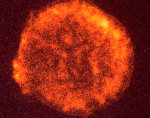 Tychos Supernova Remnant in X ray
7.03.1999
How often do stars explode? By looking at external galaxies, astronomers can guess that these events, known as a supernovae, should occur about once every 30 years in a typical spiral galaxy like our MilkyWay.
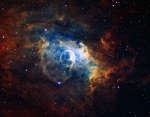 NGC 7635: The Bubble Nebula
11.10.2011
It's the bubble versus the cloud. NGC 7635, the Bubble Nebula, is being pushed out by the stellar wind of massive central star BD+602522. Next door, though, lives a giant molecular cloud, visible to the right. At this place in space, an irresistible force meets an immovable object in an interesting way.
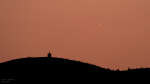 The Last Days of Venus as the Evening Star
5.10.2018
That's not a young crescent Moon poised above the hills along the western horizon at sunset. It's Venus in a crescent phase. About 54 million kilometers away and less than 20 percent illuminated, it was captured by telescope and camera on September 30 near Bacau, Romania.
|
January February |
|||||||||||||||||||||||||||||||||||||||||||||||||