
|
You entered: telescope
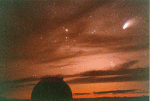 Sunset with Hale-Bopp at Keck
5.05.1997
A famous star cluster and observatory highlight this picture of Comet Hale-Bopp. Taken last week from the observatory summit of Hawaii's Mauna Kea Volcano, the dome of the new 10-meter Keck II telescope appears silhouetted on the lower left.
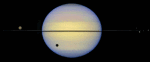 Saturn's Rings Seen Sideways
24.05.1997
Saturn's rings are actually very thin. This picture from the Hubble Space Telescope was taken on August 6, 1995 when the rings lined up sideways as seen from Earth. Saturn's largest moon Titan is seen on the left, and Titan's shadow can be seen on Saturn's cloud tops!
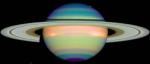 Infrared Saturn
24.04.1998
This delightfully detailed false color image of Saturn has been earmarked to celebrate the 8th anniversary of the orbiting Hubble Space Telescope. The picture is a combination of three images taken in January of this year with the Hubble's new NICMOS instrument and shows the lovely ringed planet in reflected infrared light.
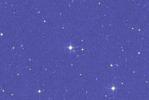 A Planet For Gliese 876
26.06.1998
Centered in this unremarkable, 1/4 degree wide patch of sky in the constellation Aquarius is the star Gliese 876. Gliese 876 is smaller than the Sun, only about 1/3 as massive, and too faint to be seen without a telescope. But it is known to be one of the nearest stars, only 15 light-years distant.
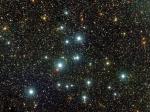 M39: Open Cluster in Cygnus
31.03.2004
Lying just at the limit of human perception is a picturesque starfield containing one of the larger open clusters on the northern sky. Spanning an angle larger than the Moon, M39's relatively few stars lie only about 800 light years distant toward the constellation of Cygnus.
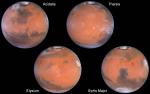 Four Faces of Mars
5.07.1999
As Mars rotates, most of its surface becomes visible. During Earth's recent pass between Mars and the Sun, the Hubble Space Telescope was able to capture the most detailed time-lapse pictures ever from the Earth. Dark and light sand and gravel create an unusual blotted appearance for the red planet.
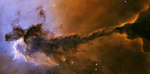 The Fairy of Eagle Nebula
9.12.2007
The dust sculptures of the Eagle Nebula are evaporating. As powerful starlight whittles away these cool cosmic mountains, the statuesque pillars that remain might be imagined as mythical beasts. Pictured above is one of several striking dust pillars of the Eagle Nebula that might be described as a gigantic alien fairy.
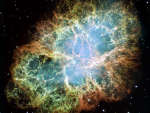 M1: The Crab Nebula from Hubble
17.02.2008
This is the mess that is left when a star explodes. The Crab Nebula, the result of a supernova seen in 1054 AD, is filled with mysterious filaments. The filaments are not only tremendously...
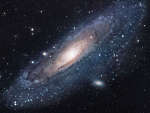 M31: The Andromeda Galaxy
10.05.2009
Andromeda is the nearest major galaxy to our own Milky Way Galaxy. Our Galaxy is thought to look much like Andromeda. Together these two galaxies dominate the Local Group of galaxies. The diffuse light from Andromeda is caused by the hundreds of billions of stars that compose it.
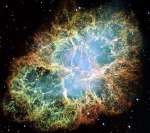 M1: The Crab Nebula from Hubble
25.10.2009
This is the mess that is left when a star explodes. The Crab Nebula, the result of a supernova seen in 1054 AD, is filled with mysterious filaments. The filaments are not only tremendously...
|
January February March April May |
|||||||||||||||||||||||||||||||||||||||||||||||||