
|
You entered: telescope
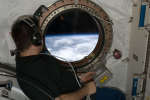 Home from Above
30.12.2008
There's no place like home. Peering out of the window of the International Space Station (ISS), astronaut Greg Chamitoff takes in the planet on which we were all born. About 350 kilometers up, the ISS is high enough so that the Earth's horizon appears clearly curved.
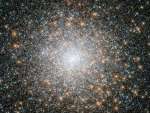 Globular Cluster M15 from Hubble
19.11.2013
Stars, like bees, swarm around the center of bright globular cluster M15. This ball of over 100,000 stars is a relic from the early years of our Galaxy, and continues to orbit the Milky Way's center.
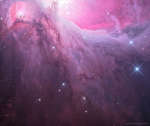 M43: Orion Falls
12.12.2018
Is there a waterfall in Orion? No, but some of the dust in M43 appears similar to a waterfall on Earth. M43, part of the Orion Molecular Cloud Complex, is the often imaged but rarely mentioned neighbor of the more famous M42.
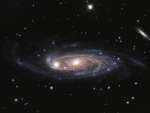 Rubin s Galaxy
25.01.2020
In this Hubble Space Telescope image the bright, spiky stars lie in the foreground toward the heroic northern constellation Perseus and well within our own Milky Way galaxy. In sharp focus beyond is UGC 2885, a giant spiral galaxy about 232 million light-years distant.
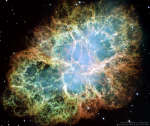 APOD: 2023 January 15 Б M1: The Crab Nebula from Hubble
15.01.2023
This is the mess that is left when a star explodes. The Crab Nebula, the result of a supernova seen in 1054 AD, is filled with mysterious filaments. The filaments are not only tremendously...
 Barred Spiral Galaxy NGC 5335
26.04.2025
This stunning portrait of NGC 5335 was captured by the Hubble Space Telescope. Some 170,000 light-years across and over 200 million light-years away toward the constellation Virgo, the magnificent spiral galaxy is seen face-on in Hubble's view.
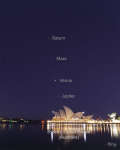 APOD: 2026 February 24 Б Planet Parade over Sydney Opera House
24.02.2026
Look up this week and see a whole bunch of planets. Just after sunset, looking west (mostly), planets Mercury, Venus, Saturn, and Jupiter will all be visible to the unaided eye simultaneously. If you have a telescope, planets Uranus and Neptune can also be seen.
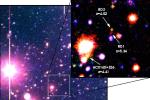 A Baby Galaxy
24.03.1998
What's the farthest galaxy known? The answer keeps changing as astronomers compete to find new galaxies which top the list. The new record holder is now the faint red smudge indicated in the above image by the arrow.
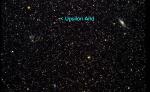 Where is Upsilon Andromedae
22.04.1999
Astronomers recently announced the detection of three large planets orbiting the star Upsilon Andromedae - the first planetary system known to orbit a normal star other than our Sun. These planets were not directly photographed but found through a Doppler technique developed to use large telescopes to search nearby stars for wobbling planetary signatures.
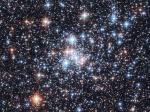 Open Cluster NGC 290: A Stellar Jewel Box
1.05.2006
Jewels don't shine this bright -- only stars do. Like gems in a jewel box, though, the stars of open cluster NGC 290 glitter in a beautiful display of brightness and color. The photogenic cluster, pictured above, was captured recently by the orbiting Hubble Space Telescope.
|
January February March April May |
|||||||||||||||||||||||||||||||||||||||||||||||||