
|
You entered: telescope
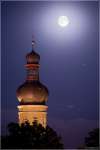 A Galilean Night
23.10.2009
Driving along on a summer evening, near the small town of Weikersheim in southern Germany, photographer Jens Hackmann had to stop. He couldn't resist pointing his camera and telephoto lens at this lovely conjunction of a Full Moon and planet Jupiter looming near the steeple of a local church.
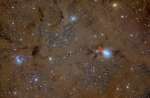 Stardust in Perseus
4.02.2010
This cosmic expanse of dust, gas, and stars covers close to 3 degrees on the sky in the heroic constellation Perseus. Right of center in the gorgeous skyscape is the dusty blue reflection nebula NGC 1333, about 1,000 light-years away. At that estimated distance, the field of view is about 50 light-years across.
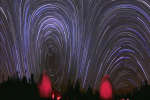 Warped Sky: Star Trails Panorama
11.07.2010
What's happened to the sky? A time warp, of sorts, and a digital space warp too. The time warp occurs because this image captured in a single frame a four hour exposure of the night sky. As a result, prominent star trails are visible.
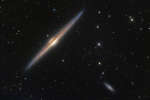 NGC 4565: Galaxy on Edge
15.10.2011
Magnificent spiral galaxy NGC 4565 is viewed edge-on from planet Earth. Also known as the Needle Galaxy for its narrow profile, bright NGC 4565 is a stop on many telescopic tours of the northern sky, in the faint but well-groomed constellation Coma Berenices.
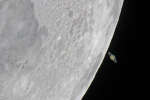 The Moons Saturn
7.04.2013
Just days after sharing the western evening sky with Venus in 2007, the Moon moved on to Saturn - actually passing in front of the ringed planet Saturn when viewed in skies over Europe, northern Africa, and western Asia.
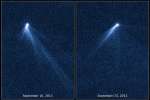 The Unexpected Tails of Asteroid P5
12.11.2013
What is happening to asteroid P/2013 P5? No one is sure. For reasons unknown, the asteroid is now sporting not one but six discernible tails. The above images were taken two months ago by the orbiting Hubble Space Telescope and show the rapidly changing dust streams.
 NGC 604: Giant Stellar Nursery
25.04.2024
Located some 3 million light-years away in the arms of nearby spiral galaxy M33, giant stellar nursery NGC 604 is about 1,300 light-years across. That's nearly 100 times the size of the Milky Way's Orion Nebula, the closest large star forming region to planet Earth.
 APOD: 2025 January 1 Б Alpha Centauri: The Closest Star System
1.01.2025
The closest star system to the Sun is the Alpha Centauri system. Of the three stars in the system, the dimmest -- called Proxima Centauri -- is actually the nearest star. The bright stars Alpha Centauri...
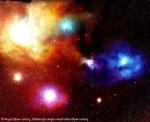 Antares and Rho Ophiuchi
21.05.2000
Why is the sky near Antares and Rho Ophiuchi so colorful? The colors result from a mixture of objects and processes. Fine dust illuminated from the front by starlight produces blue reflection nebulae. Gaseous clouds whose atoms are excited by ultraviolet starlight produce reddish emission nebulae. Backlit dust clouds block starlight and so appear dark.
 The X-ray Timing Explorer
3.01.1996
Launched Saturday on a Delta rocket, the X-ray Timing Explorer (XTE) will watch the sky for rapid changes in X-rays. XTE carries three separate X-ray telescopes. The Proportional Counter Array (PCA) and the High Energy X-ray Timing Experiment (HEXTE) will provide the best timing information in the widest X-ray energy range yet available.
|
January February March April May |
|||||||||||||||||||||||||||||||||||||||||||||||||