
|
You entered: telescope
 Shakespeare in Space
29.12.2023
In 1986, Voyager 2 became the only spacecraft to explore ice giant planet Uranus close up. Still, this newly released image from the NIRCam (Near-Infrared Camera) on the James Webb Space Telescope offers a detailed look at the distant world. The tilted outer planet rotates on its axis once in about 17 hours.
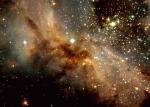 M17: Omega Nebula Star Factory
19.09.2000
In the depths of the dark clouds of dust and molecular gas known as M17, stars continue to form. Visible in the above recently released representative-color photograph of M17 by the New Technology Telescope are clouds so dark that they appear almost empty of near infrared light.
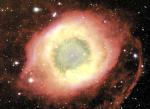 The Helix Nebula from CFHT
28.08.2000
One day our Sun may look like this. The Helix Nebula is the closest example of a planetary nebula created at the end of the life of a Sun-like star. The outer gasses of the star expelled into space appear from our vantage point as if we are looking down a helix.
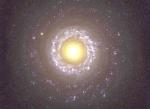 Spiral Galaxy NGC 7742
1.07.2001
This might resemble a fried egg you've had for breakfast, but it's actually much larger. In fact, ringed by blue-tinted star forming regions and faintly visible spiral arms, the yolk-yellow center of this face-on spiral galaxy, NGC 7742, is about 3,000 light-years across.
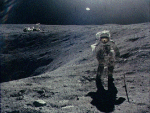 Apollo 16: Exploring Plum Crater
7.06.1996
Apollo 16 spent three days on Earth's Moon in April 1972. The fifth lunar landing mission out of six, Apollo 16 was famous for deploying and using an ultraviolet telescope as the first lunar observatory, and for collecting rocks and data on the mysterious lunar highlands. In the above picture, astronaut John W.
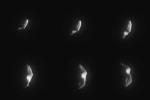 NEAR to Asteroid Eros
28.12.1998
On December 23, the NEAR spacecraft flew by asteroid 433 Eros. NEAR was originally scheduled to brake and orbit Eros, but an unexpected shutdown of its main engine caused this plan to be aborted. NEAR will now be reset and attempt to return to orbit Eros in early 2000.
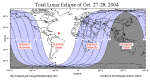 Total Lunar Eclipse Tonight
27.10.2004
Go outside tonight and see the total lunar eclipse. Tonight's eclipse is easy and convenient for much of the world to see. Anyone who can spot a full Moon -- even during the day -- can see it fade out as the Earth's shadow engulfs it.
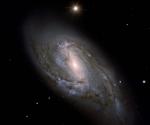 Dusty Spiral M66
2.09.2006
When morning twilight came to the Paranal Observatory in Chile, astronomers Mark Neeser and Peter Barthel interrupted their search for faint quasars, billions of light-years away. And just for a moment, they used Very Large Telescopes at the European Southern Observatory to appreciate the beauty of the nearby Universe.
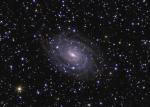 NGC 6384: Beyond the Stars
12.07.2007
The universe is filled with galaxies. But to see them astronomers must look out beyond the stars of our galaxy, the Milky Way. For example, consider this colorful telescopic view of spiral galaxy NGC 6384, about 80 million light-years away in the direction of the constellation Ophiuchus.
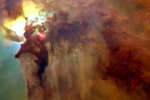 In the Center of the Lagoon Nebula
19.10.2008
The center of the Lagoon Nebula is a whirlwind of spectacular star formation. Visible on the upper left, at least two long funnel-shaped clouds, each roughly half a light-year long, have been formed by extreme stellar winds and intense energetic starlight. The tremendously bright nearby star, Hershel 36, lights the area.
|
January February |
|||||||||||||||||||||||||||||||||||||||||||||||||