
|
You entered: telescope
 APOD: 2025 August 5 Б NGC 6072: A Complex Planetary Nebula from Webb
4.08.2025
Why is this nebula so complex? The Webb Space Telescope has imaged a nebula in great detail that is thought to have emerged from a Sun-like star. NGC 6072 has been resolved into one of the more unusual and complex examples of planetary nebula.
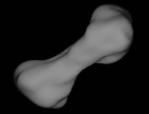 Dog-Bone Shaped Asteroid 216 Kleopatra
10.05.2000
An asteroid the size of New Jersey that orbits the Sun between Mars and Jupiter has been discovered to have an unusual dog-bone shape. Asteroid 216 Kleopatra, recently mapped with Earth-based radar, reflects radio waves so well that astronomers speculate it is composed mostly of metals such as nickel and iron.
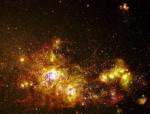 NGC 4214: Star Forming Galaxy
6.01.2000
Dazzling displays of star formation abound across the face of galaxy NGC 4214, a mere 13 million light-years away in the northern constellation Canes Venatici. While this 1997 Hubble Space Telescope image shows...
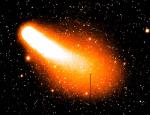 Comet Linear (WM1) Brightens
5.12.2001
A comet bright enough to be seen with binoculars is swooping into southern skies. Comet C/2000 WM1 (LINEAR) continues to brighten and develop tails as it nears its closest approach of the Sun in late January 2002.
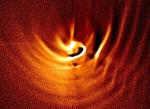 Hale-Bopp's Hoods
14.04.1997
Comet Hale-Bopp is spinning. The nucleus of the comet is a dirty snowball about 25 miles in diameter that spins about once every 12 hours. As Comet Hale-Bopp spins, parts of the comet's surface shoot away in jets.
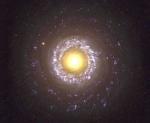 Spiral Galaxy NGC 7742
26.07.2003
This might resemble a fried egg you've had for breakfast, but it's actually much larger. In fact, ringed by blue-tinted star forming regions and faintly visible spiral arms, the yolk-yellow center of this face-on spiral galaxy, NGC 7742, is about 3,000 light-years across.
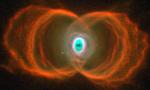 MyCn18: An Hourglass Nebula
14.09.1997
The sands of time are running out for the central star of this hourglass-shaped planetary nebula. With its nuclear fuel exhausted, this brief, spectacular, closing phase of a Sun-like star's life occurs as its outer layers are ejected - its core becoming a cooling, fading white dwarf.
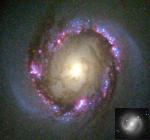 NGC 4314: A Nuclear Starburst Ring
15.06.1998
Is this old galaxy up to new tricks? The barred spiral galaxy NGC 4314 is billions of years old, but its appearance has changed markedly over just the past few millions of years. During that time, a nuclear ring of bright young stars has been evolving.
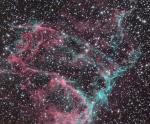 IC1340 in the Eastern Veil
26.09.2003
These ghostly filaments of interstellar gas are just a small part of the expansive Veil Nebula, seen against a rich field of background stars in the long-necked constellation Cygnus. Also known as the Cygnus...
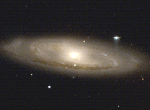 M65 Without Moth
7.08.1998
Messier 65 (M65) is a bright spiral galaxy of stars only 35 million light-years away in the constellation Leo. With very tightly wound spiral arms, a large central bulge, and well defined dust lanes, this galaxy is a member of a group of galaxies known as the Leo triplet.
|
January February |
|||||||||||||||||||||||||||||||||||||||||||||||||