
|
You entered: telescope
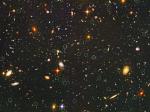 HUDF: Dawn of the Galaxies
29.09.2004
When did galaxies form? Faint red smudges identified on the deepest optical sky image ever taken may well be members of the first class of galaxies. Detailed inspection of the Hubble Ultra Deep Field...
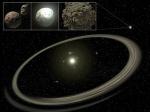 Old Planetary Dust Disks Found by SST
19.10.2004
Why are some older stars surrounded by dust? Observations from the Spitzer Space Telescope by a team led by George Rieke (U. Arizona) were expected to show that young stars, on the order of one million years old, have large dust disks, while relatively older stars, between 10 and 100 million years old, have none.
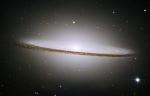 The Sombrero Galaxy from HST
15.01.2006
Why does the Sombrero Galaxy look like a hat? Reasons include the Sombrero's unusually large and extended central bulge of stars, and dark prominent dust lanes that appear in a disk that we see nearly edge-on. Billions of old stars cause the diffuse glow of the extended central bulge.
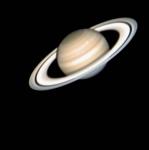 A New Storm on Saturn
27.01.2006
Presently at opposition in planet Earth's sky, Saturn is well placed for telescopic observations. On Wednesday two amateur astronomers took full advantage of the situation from Melun, near Paris, France. With...
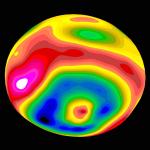 A Map of Asteroid Vesta
20.08.2006
Vesta is a huge rock 500 kilometers across that orbits out past Mars. In 1997, the above map of Vesta created using the Hubble Space Telescope was released showing a rugged surface highlighted by a single crater spanning nearly the entire length of the asteroid.
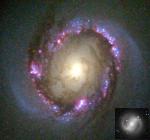 NGC 4314: A Nuclear Starburst Ring
12.12.1999
Is this old galaxy up to new tricks? The barred spiral galaxy NGC 4314 is billions of years old, but its appearance has changed markedly over just the past few millions of years. During that time, a nuclear ring of bright young stars has been evolving.
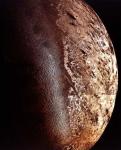 Triton: Neptune's Largest Moon
10.10.1999
One hundred and fifty three years ago, on October 10th, 1846, William Lassell was observing the newly discovered planet Neptune. He was attempting to confirm his observation, made just the previous week, that Neptune had a ring. But this time he discovered that Neptune had a satellite as well.
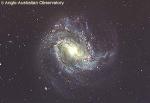 M83: A Barred Spiral Galaxy
26.09.1999
M83 is a bright spiral galaxy that can be found with a small telescope in the constellation of Hydra. It takes light about 15 million years to reach us from M83. M83 is quite a typical spiral - much like our own Milky Way Galaxy.
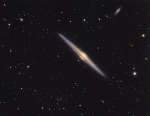 NGC 4565: Galaxy on Edge
4.03.2010
Magnificent spiral galaxy NGC 4565 is viewed edge-on from planet Earth. Also known as the Needle Galaxy for its narrow profile, bright NGC 4565 is a stop on many telescopic tours of the northern sky, in the faint but well-groomed constellation Coma Berenices.
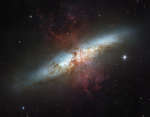 M82: Galaxy with a Supergalactic Wind
26.03.2012
What's lighting up the Cigar Galaxy? M82, as this irregular galaxy is also known, was stirred up by a recent pass near large spiral galaxy M81. This doesn't fully explain the source of the red-glowing outwardly expanding gas, however.
|
January February |
|||||||||||||||||||||||||||||||||||||||||||||||||