
|
You entered: telescope
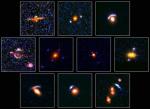 A Gallery of Gravitational Mirages
1.06.1999
The deeper you peer into the universe, the harder it is to see straight. The reason is that distant galaxies act as gravitational lenses, deflecting light that passes nearby. These deflections result in the distortion of background sources, and in some cases the creation of multiple images.
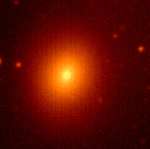 Dwarf Elliptical Galaxy M32
6.01.1996
Being the largest galaxy around can sometimes make you popular. Pictured is M31's companion galaxy M32. M31, the Andromeda galaxy, is the largest galaxy in our Local Group of galaxies - even our tremendous Milky Way Galaxy is smaller.
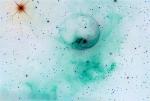 The Bubble Nebula from NOAO
17.06.2003
It's the bubble versus the cloud. NGC 7635, the Bubble Nebula, is being pushed out by the stellar wind of massive central star BD+602522. Next door, though, lives a giant molecular cloud, visible above to the lower right.
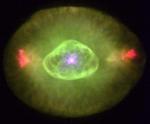 NGC 6826: The Blinking Eye
19.12.1997
The colorful planetary nebula phase of a sun-like star's life is brief. Almost in the "blink of an eye" - cosmically speaking - the star's outer layers are cast off, forming an expanding emission nebula. This nebula lasts perhaps 10 thousand years compared to a 10 billion year stellar life span.
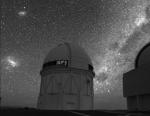 A Cerro Tololo Sky
13.03.2004
High atop a Chilean mountain lies one of the premier observatories of the southern sky: the Cerro Tololo Inter-American Observatory (CTIO). Pictured above is the dome surrounding one of the site's best known instruments, the 4-meter Blanco Telescope.
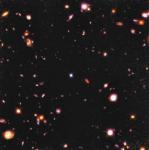 The Hubble Deep Field in Infrared
12.10.1998
Galaxies this faint have never been seen before. In 1996 the Hubble Space Telescope (HST) created one of the most famous pictures of modern astronomy, the Hubble Deep Field (HDF). Now HST has returned to a piece of the HDF for a long exposure by its new NICMOS camera, sensitive to infrared light.
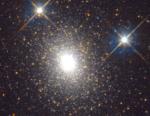 A Giant Globular Cluster in M31
17.10.1998
This cluster of stars, known as G1, is the brightest globular cluster in the whole Local Group of galaxies. Also called Mayall II, it orbits the center of the largest nearby galaxy: M31. G1 contains over 300,000 stars and is almost as old as the entire universe.
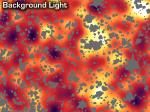 Light from the First Stars
2.01.2007
What were the first stars like? No one is yet sure. Our Sun is not a first-generation star. It is not even second generation. The first stars to appear in the universe likely came and went about 13 billion years ago.
 Breaking Distant Light
4.01.2009
In the distant universe, time appears to run slow. Since time-dilated light appears shifted toward the red end of the spectrum (redshifted), astronomers are able to use cosmological time-slowing to help measure vast distances in the universe.
 Wolf Lundmark Melotte
19.05.2017
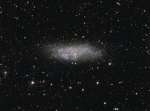
Named for the three astronomers instrumental in its discovery and identification, Wolf - Lundmark - Melotte (WLM) is a lonely dwarf galaxy. Seen toward the mostly southern constellation Cetus, about 3 million light-years from the Milky Way, it is one of the most remote members of our local galaxy group.
|
January February March April May |
|||||||||||||||||||||||||||||||||||||||||||||||||