
|
You entered: telescope
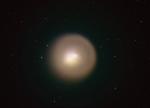 Golden Comet Holmes
3.11.2007
Surprising Comet Holmes remains easily visible as a round, fuzzy cloud in the northern constellation Perseus. Skywatchers with telescopes, binoculars, or those that just decide to look up can enjoy the solar system's latest prodigy as it glides about 150 million kilometers from Earth, beyond the orbit of Mars.
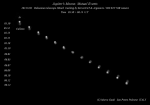 Io and Callisto Mutual Event
25.11.2014
A 24 minute sequence from top to bottom, this intriguing series of telescopic frames tracks the occultation of Io by Callisto, two of Jupiter's Galilean moons, from San Pietro Polesine, Italy, planet Earth. A challenging observational project using a small telescope, the two contrasting Jovian worlds are both slightly larger than Earth's Moon.
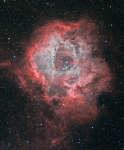 A Cosmic Rose: The Rosette Nebula in Monoceros
12.04.2019
The Rosette Nebula, NGC 2237, is not the only cosmic cloud of gas and dust to evoke the imagery of flowers, but it is the most famous. At the edge of a large molecular cloud in Monoceros some 5,000 light years away, the petals of this cosmic rose are actually a stellar nursery.
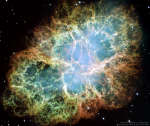 M1: The Crab Nebula from Hubble
6.09.2020
This is the mess that is left when a star explodes. The Crab Nebula, the result of a supernova seen in 1054 AD, is filled with mysterious filaments. The filaments are not only tremendously...
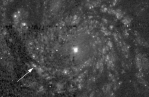 A Supernova in the Whirlpool
21.04.1996
In 1994, a new star in a distant galaxy was seen by amateur astronomers, who alerted the world to their discovery of a supernova. Near the nucleus of spiral galaxy M51, popularly known...
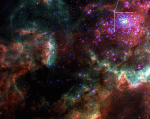 In the Center of 30 Doradus
24.05.1996
In the center of 30 Doradus lies a huge cluster of the largest, hottest, most massive stars known. The center of this cluster, known as R136, is boxed in the upper right portion of the above picture.
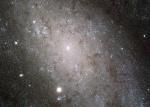 The Stars of NGC 300
16.04.2004
Like grains of sand on a cosmic beach, individual stars of large spiral galaxy NGC 300 are resolved in this sharp image from the Hubble Space Telescope's Advanced Camera for Surveys (ACS).
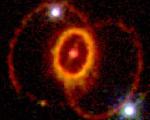 The Mysterious Rings of Supernova 1987A
6.02.2000
What's causing those odd rings in supernova 1987A? In 1987, the brightest supernova in recent history occurred in the Large Magellanic Clouds. At the center of the picture is an object central to the remains of the violent stellar explosion.
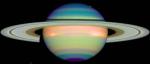 Infrared Saturn
24.07.1999
This delightfully detailed false color image of Saturn was earmarked to celebrate the 8th anniversary of the orbiting Hubble Space Telescope. The picture is a combination of three images taken in January 1998 and shows the lovely ringed planet in reflected infrared light.
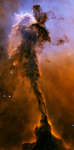 The Fairy of Eagle Nebula
21.08.2011
The dust sculptures of the Eagle Nebula are evaporating. As powerful starlight whittles away these cool cosmic mountains, the statuesque pillars that remain might be imagined as mythical beasts. Pictured above is one of several striking dust pillars of the Eagle Nebula that might be described as a gigantic alien fairy.
|
January February March April May |
|||||||||||||||||||||||||||||||||||||||||||||||||