
|
You entered: telescope
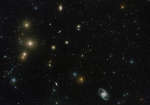 The Fornax Cluster of Galaxies
11.06.2016
Named for the southern constellation toward which most of its galaxies can be found, the Fornax Cluster is one of the closest clusters of galaxies. About 62 million light-years away, it is almost...
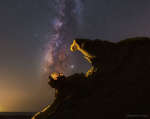 Jupiter Engulfed and the Milky Way
7.08.2019
This is a good month to see Jupiter. To find our Solar System's largest planet in your sky, look toward the southeast just after sunset -- Jupiter should be the brightest object in that part of the sky.
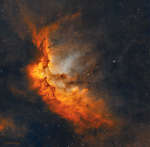 NGC 7380: The Wizard Nebula
14.11.2022
What powers are being wielded in the Wizard Nebula? Gravitation strong enough to form stars, and stellar winds and radiations powerful enough to create and dissolve towers of gas. Located only 8,000 light years away, the Wizard nebula, featured here, surrounds developing open star cluster NGC 7380.
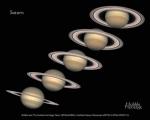 The Seasons of Saturn
2.07.2001
Soon it will be winter in Saturn's northern hemisphere. Since Saturn is tilted in its orbit around the Sun, it has seasons just like the Earth. When a hemisphere is tilted so that the Sun passes more directly overhead, summer occurs. Half an orbit later -- about 15 (Earth) years for Saturn -- winter occurs.
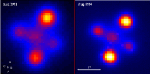 Microlensing of the Einstein Cross
11.07.1995
The famous "Einstein Cross" is a case where a single object is seen four times. Here a very distant QSO happened to be placed right behind a massive galaxy. The gravitational effect...
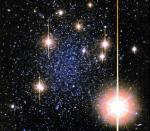 Pegasus dSph: Little Galaxy of the Local Group
22.01.1999
The Pegasus dwarf spheroidal galaxy (Peg dSph) is a small, newly recognized member of the Local Group of Galaxies. Likely a satellite companion of the Local Group's dominant player, the large spiral Andromeda (M31), the Pegasus dwarf galaxy is almost hidden in the glare of relatively bright foreground stars in our own Milkyway.
 Dust Sculptures in the Rosette Nebula
10.01.2005
What creates the cosmic dust sculptures in the Rosette Nebula? Noted for the common beauty of its overall shape, parts of the Rosette Nebula, also known as NGC 2244, show beauty even when viewed up close.
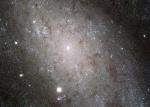 The Stars of NGC 300
20.08.2005
Like grains of sand on a cosmic beach, individual stars of large spiral galaxy NGC 300 are resolved in this sharp image from the Hubble Space Telescope's Advanced Camera for Surveys (ACS). The inner region of the galaxy is pictured, spanning about 7,500 light-years.
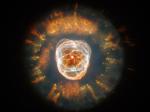 The Eskimo Nebula from Hubble
9.07.2006
In 1787, astronomer William Herschel discovered the Eskimo Nebula. From the ground, NGC 2392 resembles a person's head surrounded by a parka hood. In 2000, the Hubble Space Telescope imaged the Eskimo Nebula. From space, the nebula displays gas clouds so complex they are not fully understood.
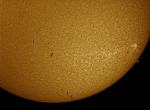 Mercury and the Chromosphere
10.11.2006
Enjoying Wednesday's transit of Mercury from Dallas, Texas, astronomer Phil Jones recorded this detailed image of the Sun. Along with a silhouette of the innermost planet, a network of cells and dark filaments can be seen against a bright solar disk with spicules and prominences along the Sun's edge.
|
January February March April May |
|||||||||||||||||||||||||||||||||||||||||||||||||