
|
You entered: telescope
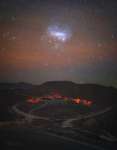 Under the Galaxy
13.10.2017
The Large Magellanic Cloud, a satellite galaxy of the Milky Way, stands above the southern horizon in this telephoto view from Las Campanas Observatory, planet Earth. In the dark September skies of the Chilean Atacama desert, the small galaxy has an impressive span of about 10 degrees or 20 Full Moons.
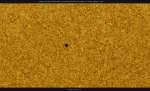 Mercury in Silhouette
13.11.2019
The small, dark, round spot in this solar close up is planet Mercury. In the high resolution telescopic image, a colorized stack of 61 sharp video frames, a turbulent array of photospheric convection cells tile the bright solar surface. Mercury's more regular silhouette still stands out though.
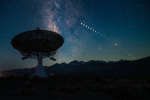 Mid Eclipse and Milky Way
27.05.2021
May's perigee Full Moon slid through Earth's shadow yesterday entertaining night skygazers in regions around the Pacific. Seen from western North America, it sinks toward the rugged Sierra Nevada mountain range in this time-lapse series of the total lunar eclipse.
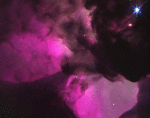 A Close-Up of the Lagoon's Hourglass
21.08.1996
In the central part of the Lagoon Nebula lies the above pictured Hourglass Nebula. In this region of recent star formation, obscuring dark lanes of dust permeate the red-glowing hydrogen gas. Blocking some...
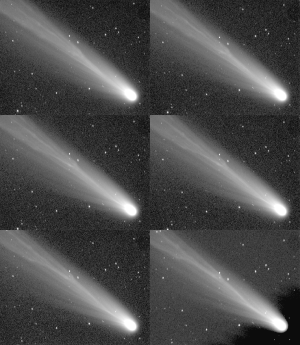 Tail Wags of Comet Ikeya Zhang
15.05.2002
As Comet Ikeya-Zhang approached the Sun two months ago, it developed a complex blue ion tail. The tail was composed of ions that boiled off the nucleus and were pushed away from the Sun by the out-flowing fast-moving particles of the solar wind.
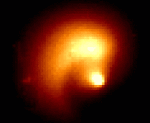 Comet Hale-Bopp Update
30.10.1995
Will comet Hale-Bopp become the brightest comet of the Century in early 1997? Since its discovery in July this year, Hale-Bopp has caused much speculation. Even though it is still beyond the orbit of Jupiter it is astonishingly bright and expected to get much brighter as it plunges inward, toward the Sun.
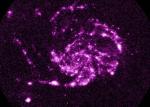 M101: An Ultraviolet View
8.06.1997
This giant spiral galaxy, Messier 101 (M101), was photographed by the Ultraviolet Imaging Telescope (UIT). UIT flew into orbit as part of the Astro 2 mission on-board the Space Shuttle Endeavour in March 1995. The image has been processed so that the colors (purple to white) represent an increasing intensity of ultraviolet light.
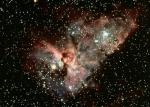 The Keyhole Nebula
12.01.1998
The dark dusty Keyhole Nebula gets its name from its unusual shape. Officially designated NGC 3324, the Keyhole Nebula is a smaller region superposed on the larger Eta Carina Nebula. These nebulae were created by the dying star Eta Carina, which is prone to violent outbursts during its final centuries.
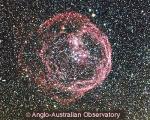 Henize 70: A SuperBubble In The LMC
13.06.1998
Stars with tens of times the mass of the Sun profoundly affect their galactic environment. Churning and mixing the interstellar gas and dust clouds they leave their mark in the compositions and locations of future generations of stars and star systems.
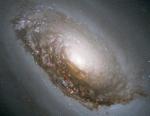 M64: The Sleeping Beauty Galaxy
11.02.2004
The Sleeping Beauty galaxy may appear peaceful at first sight but it is actually tossing and turning. In an unexpected twist, recent observations have shown that the gas in the outer regions of this photogenic spiral is rotating in the opposite direction from all of the stars!
|
January February March April May |
|||||||||||||||||||||||||||||||||||||||||||||||||