
|
You entered: telescope
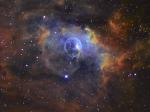 NGC 7635: The Bubble Nebula
7.11.2005
It's the bubble versus the cloud. NGC 7635, the Bubble Nebula, is being pushed out by the stellar wind of massive central star BD+602522. Next door, though, lives a giant molecular cloud, visible above to the lower right.
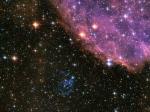 Supernova Remnant E0102 from Hubble
29.08.2006
It's the blue wisp near the bottom that's the remnant of a tremendous recent supernova explosion. The large pink structure looming to the upper right is part of N76, a large star forming region in our neighboring Small Magellanic Cloud (SMC) galaxy. The supernova remnant wisp, with full coordinate name 1E0102.
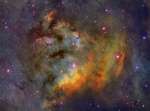 Sharpless 171
18.10.2008
Cosmic pillars of cold molecular gas and clouds of dark dust lie within Sharpless 171, a star-forming region some 3,000 light-years away in the royal constellation Cepheus. This tantalizing false-color skyscape spans about 20 light-years across the nebula's bright central region.
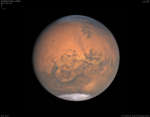 Close Mars
31.08.2018
Still bright in evening skies, Mars was just past opposition and closest to Earth on July 31, a mere 57.6 million kilometers away. Captured only a week later, this remarkable image shows...
 Messier 4
29.11.2024
Messier 4 can be found west of bright red-giant star Antares, alpha star of the constellation Scorpius. M4 itself is only just visible from dark sky locations, even though the globular cluster of 100,000 stars or so is a mere 5,500 light-years away.
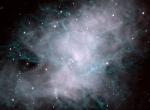 The Crab Nebula in Blue and White
11.07.2000
The Crab Nebula is a complex shell of expanding gas. The Crab Nebula formed from a star that was seen to explode in a supernova about 1000 years ago. This two color composite image taken with the WIYN 3.5-meter telescope shows in great detail filamentary structure of the glowing hydrogen gas.
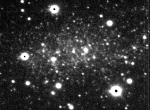 The Closest Galaxy: The Sagittarius Dwarf
29.03.1997
What's the closest galaxy to our Milky Way? For many years astronomers thought it was the Large Magellanic Cloud (LMC). But the seemingly insignificant fuzzy patch shown above turned out to be part of a galaxy that is even closer.
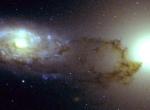 Dusting Spiral Galaxies
16.01.1998
How much dust is in spiral galaxies? Does it block out much of the starlight? Because astronomers rely on an accurate knowledge of galaxy properties to investigate a wide range of problems, like galaxy and quasar evolution and the nature of dark matter, answers to simple questions like this are key.
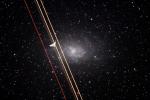 Just Passing Through
25.08.2007
M33 is a big, beautiful spiral galaxy a mere 3 million light-years away, understandably a popular target for enthusiastic astro-imagers. Just as understandably, interfering satellite trails and airplane streaks that are becoming more common in planet Earth's busy night sky are processed out of their finished images.
 Stardust in Perseus
29.11.2007
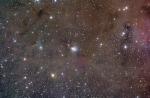
This cosmic expanse of dust, gas, and stars covers some 4 degrees on the sky in the heroic constellation Perseus. Centered in the gorgeous skyscape is the dusty blue reflection nebula NGC 1333, about 1,000 light-years away. At that estimated distance, the field of view is nearly 70 light-years across.
|
January February March April May |
|||||||||||||||||||||||||||||||||||||||||||||||||