
|
You entered: telescope
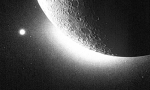 Sunshine, Earthshine at the Lunar Limb
30.05.1996
This dramatic image of the Moon's edge against a background of distant stars is from a perspective impossible for groundbased telescopes. It was taken by a star tracker camera onboard the Clementine spacecraft.
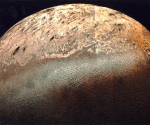 Triton: Neptune's Largest Moon
23.11.1997
On October 10th, 1846, William Lassell was observing the newly discovered planet Neptune. He was attempting to confirm his observation, made just the previous week, that Neptune had a ring. But this time he discovered that Neptune had a satellite as well.
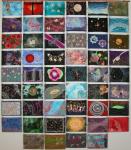 Astronomy Quilt of the Week
17.10.2003
Demonstrating her mastery of a traditional astronomical imaging technique quilter and astronomy enthusiast Judy Ross has produced this spectacular compostion of "Astronomy Quilt Piece of the Week". Her year-long effort resulted in an arrangement...
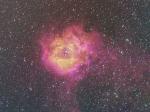 The Rosette Nebula
14.02.2005
Would the Rosette Nebula by any other name look as sweet? The bland New General Catalog designation of NGC 2237 doesn't appear to diminish the appearance of the this flowery emission nebula. Inside the nebula lies an open cluster of bright young stars designated NGC 2244.
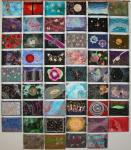 Astronomy Quilt of the Week
16.10.2005
Demonstrating her mastery of a traditional astronomical imaging technique quilter and astronomy enthusiast Judy Ross has produced this spectacular composition of "Astronomy Quilt Piece of the Week". Her year-long effort resulted in an arrangement...
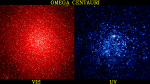 Globular Cluster Omega Centauri
4.10.1996
Does an old, red globular cluster have any hot, blue stars? The rightmost picture, taken by the Ultraviolet Imaging Telescope in ultraviolet light, shows that indeed it does. Pictured, Omega Centauri is the largest known globular cluster in our Galaxy, containing well over a million stars.
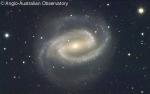 Barred Spiral Galaxy NGC 1300
4.10.2000
NGC 1300 is a large spiral galaxy that appears as a flattened figure eight. A huge bar that spans over 150,000 light-years across the galaxy center dominates its appearance. The picturesque galaxy lies about 75 million light-years distant, so that light that we see now left during the age of the dinosaurs.
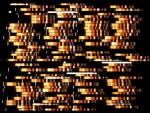 Breaking Distant Light
19.03.2002
In the distant universe, time appears to run slow. Since time-dilated light appears shifted toward the red end of the spectrum (redshifted), astronomers are able to use cosmological time-slowing to help measure vast distances in the universe.
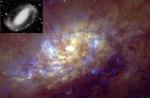 Starbirth in NGC 1808
23.03.1998
The center of galaxy NGC 1808 is bursting with new stars, but why? Being a barred spiral galaxy makes NGC 1808 somewhat similar to our own Milky Way Galaxy. But the disk of NGC 1808 (inset) is quite warped, and its center is unusually bright and blue.
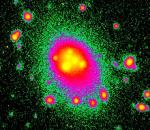 A3827: Cluster Cannibal
31.08.1998
It was mealtime in galaxy cluster Abell 3827. The hungry cluster dominant galaxy in A3827's center is seen being fed. Breakfast included five smaller galaxies unfortunate enough to wander too close to the cluster's central supergiant galaxy. The remnants of these five galaxies can be seen in the center of this false-color picture.
|
January February March April May |
|||||||||||||||||||||||||||||||||||||||||||||||||