
|
You entered: telescope
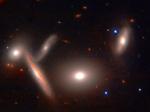 Hickson Compact Group 40
16.02.1999
Galaxies, like stars, frequently form groups. A group of galaxies is a system containing more than two galaxies but less than the tens or hundreds typically found in a cluster of galaxies. A most...
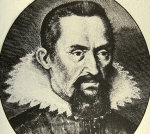 Kepler Discovers How Planets Move
6.06.1999
Johannes Kepler used simple mathematics to describe how planets move. Kepler was an assistant to the most accurate astronomical observer of the time, Tycho Brahe. Kepler was able to use Brahe's data...
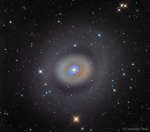 Starburst Galaxy M94
25.05.2015
What could cause the center of M94 to be so bright? Spiral galaxy M94 has a ring of newly formed stars surrounding its nucleus, giving it not only an unusual appearance but also a strong interior glow.
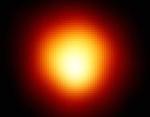 Betelgeuse, Betelgeuse, Betelgeuse
5.06.1999
Betelgeuse (sounds a lot like "beetle juice"), a red supergiant star about 600 light years distant, is seen in this Hubble Space Telescope image - the first direct picture of the surface of a star other than the Sun. While Betelgeuse is cooler than the Sun, it is more massive and over 1000 times larger.
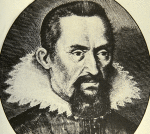 Kepler Discovers How Planets Move
13.01.2001
Johannes Kepler used simple mathematics to describe how planets move. Kepler was an assistant to the most accurate astronomical observer of the time, Tycho Brahe. Kepler was able to use Brahe's data...
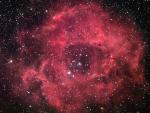 The Rosette Nebula
13.02.2001
Would the Rosette Nebula by any other name look as sweet? The bland New General Catalog designation of NGC 2237 doesn't appear to diminish the appearance of the this flowery emission nebula. Inside the nebula lies an open cluster of bright young stars designated NGC 2244.
 Announcing Comet Hale-Bopp
20.08.1995
The pictured fuzzy patch may become one of the most spectacular comets this century. Although it is very hard to predict how bright a comet will become, Comet Hale-Bopp, named for its discoverers...
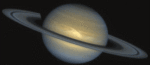 A Storm on Saturn
17.10.1995
The white wisp shown on Saturn's cloud tops is actually a major storm system only discovered in December of 1994. Saturn's clouds are composed of primarily hydrogen and helium, but the storm's white clouds are actually ammonia ice crystals that have frozen upon upheaval to the top of the atmosphere.
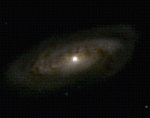 Spiral Galaxy M90
15.03.1996
Spiral galaxy M90 is near the center of the Virgo Cluster of Galaxies - the closest cluster of galaxies to the our own Milky Way Galaxy. Also dubbed NGC 4569, this galaxy has a very compact and bright nucleus.
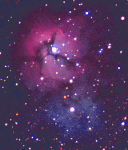 M20: The Trifid Nebula
23.07.1995
The vivid blue and violet colors present in the Trifid Nebula result from the abundance of young stars there. The light from young massive stars is quite blue and has the ability to remove electrons from surrounding gas. When these electrons re-combine with the gas, radiation rich in blue and violet light is emitted.
|
January February March April May |
|||||||||||||||||||||||||||||||||||||||||||||||||