
|
You entered: telescope
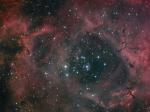 Dust and Light in the Rosette Nebula
14.02.2006
What creates the cosmic dust sculptures in the Rosette Nebula? Noted for the common beauty of its overall shape, parts of the Rosette Nebula, also known as NGC 2244, show beauty even when viewed up close.
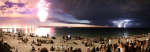 Comet Between Fireworks and Lightning
29.05.2011
Sometimes the sky itself is the best show in town. In January 2007, people from Perth, Australia gathered on a local beach to watch a sky light up with delights near and far. Nearby, fireworks exploded as part of Australia Day celebrations. On the far right, lightning from a thunderstorm flashed in the distance.
 The ISS Meets Venus
11.04.2025
Made with a telescope shaded from bright sunlight by an umbrella, on April 5 a well-planned video captured a crescent Venus shining in clear daytime skies from Shoreline, Washington, USA at 11:57AM Pacific Time. It also caught the International Space Station in this single video frame.
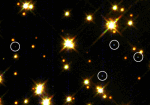 White Dwarfs Cool
10.09.1995
The circled stars in the above picture are from a class that is hard to see in the cosmos: white dwarfs. The entire photo covers a small region near the center of a globular cluster known as M4. Researchers using the Hubble Space Telescope discovered a large concentration of white dwarfs in M4.
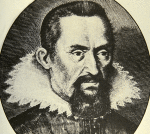 Kepler Discovers How Planets Move
31.08.1996
Johannes Kepler used simple mathematics to describe how planets move. Kepler was an assistant to the most accurate astronomical observer of the time, Tycho Brahe. Kepler was able to use Brahe's data...
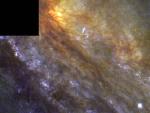 NGC 253: The Sculptor Galaxy
16.03.2003
NGC 253 is not only one of the brightest spiral galaxies visible, it is also one of the dustiest. Discovered in 1783 by Caroline Herschel in the constellation of Sculptor, NGC 253 lies only about ten million light-years distant.
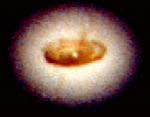 The Heart Of NGC 4261
7.11.1999
Who knows what evil lurks in the hearts of galaxies? The Hubble knows. This Hubble Space Telescope picture of the center of the nearby elliptical galaxy NGC 4261 tells one dramatic tale. The gas and dust in this disk are swirling into what is almost certainly a massive black hole.
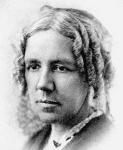 Maria Mitchell Inspires a Generation
16.10.1999
"Do not look at stars as bright spots only - try to take in the vastness of the universe." On October 1, 1847 Maria Mitchell swept the sky with her telescope and discovered a comet (comet Mitchell 1847VI).
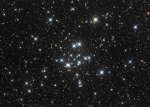 Star Cluster M34
11.02.2010
This pretty open cluster of stars, M34, is about the size of the Full Moon on the sky. Easy to appreciate in small telescopes, it lies some 1,800 light-years away in the constellation Perseus. At that distance, M34 physically spans about 15 light-years.
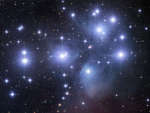 M45: The Pleiades Star Cluster
3.09.2012
Perhaps the most famous star cluster on the sky, the Pleiades can be seen without binoculars from even the depths of a light-polluted city. Also known as the Seven Sisters and M45, the Pleiades is one of the brightest and closest open clusters.
|
January February March April May |
|||||||||||||||||||||||||||||||||||||||||||||||||