
|
You entered: telescope
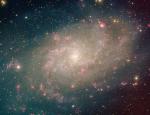 Nearby Spiral M33
1.12.2002
Spiral galaxy M33 is a mid-sized member of our Local Group of Galaxies. M33 is also called the Triangulum Galaxy for the constellation in which it resides. About four times smaller (in radius) than...
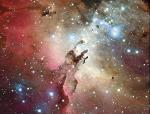 The Eagle Nebula from CFHT
12.02.2003
Bright blue stars are still forming in the dark pillars of the Eagle Nebula. Made famous by a picture from the Hubble Space Telescope in 1995, the Eagle Nebula shows the dramatic process of star formation. To the upper right of the nebula in the above picture lies the heart of the open cluster M16.
 Galaxy Cluster A2199
21.01.1997
It's bigger than a bread box. In fact, it's much bigger than all bread boxes put together. Abell 2199 is huge. In fact, it is a close, large cluster of galaxies, containing several thousands of galaxies centered around a central dominant galaxy.
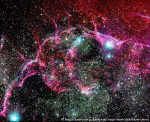 Vela Supernova Remnant in Optical
13.07.1997
About 11,000 years ago a star in the constellation of Vela exploded. This bright supernova may have been visible to the first human farmers. Today the Vela supernova remnant marks the position of a relatively close and recent explosion in our Galaxy. A roughly spherical, expanding shock wave is visible in X-rays.
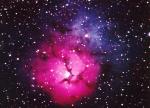 The Trifid Nebula in Red, White and Blue
7.12.1997
Three dark dust lanes give the picturesque Trifid Nebula its name. The red and blue colors of the Trifid Nebula are present in different regions and are created by different processes. A big bright star near the center of the red region appears white hot and emits light so energetic
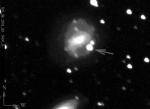 A Gamma Ray Burst Supernova
8.05.1998
Did a gamma-ray burst precede this supernova? This intriguing suggestion came to light yesterday with the discovery of an evolving supernova that is potentially coincident with the position of gamma-ray burst GRB 980425, which occurred just two weeks ago. If true, this would tie together the two most violent phenomena known in the universe.
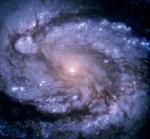 M100: A Grand Design
6.06.1998
Majestic on a truly cosmic scale, M100 is appropriately known as a Grand Design spiral galaxy. A large galaxy of over 100 billion or so stars with well defined spiral arms, it is similar to our own Milky Way.
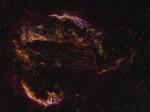 The Veil Nebula Unveiled
5.12.2005
These wisps of gas are all that remain visible of a Milky Way star. Many thousands of years ago that star exploded in a supernova leaving the Veil Nebula, pictured above. At the time...
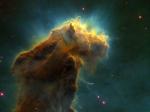 Star EGGs in the Eagle Nebula
22.10.2006
Where do stars form? One place, star forming regions known as "EGGs", are uncovered at the end of this giant pillar of gas and dust in the Eagle Nebula (M16). EGGs, short for evaporating gaseous globules, are dense regions of mostly molecular hydrogen gas that fragment and gravitationally collapse to form stars.
 Galaxies Cluster Toward the Great Attractor
3.01.2000
Galaxies dot the sky like jewels in the direction of a mass so large it is known simply as the Great Attractor. The galaxies pictured above are part of a cluster of galaxies called ACO 3627 near the center of the Great Attractor.
|
January February |
|||||||||||||||||||||||||||||||||||||||||||||||||