
|
You entered: telescope
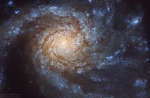 Messier 99
24.06.2021
Grand design spiral galaxy Messier 99 looks majestic on a truly cosmic scale. This recently processed full galaxy portrait stretches over 70,000 light-years across M99. The sharp view is a combination of ultraviolet, visible, and infrared image data from the Hubble Space Telescope.
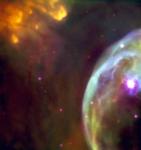 Close Up of the Bubble Nebula
18.11.1998
It's the bubble versus the cloud. NGC 7635, the Bubble Nebula, is being pushed out by the stellar wind of massive central star BD+602522. Next door, though, lives a giant molecular cloud, visible above to the upper left.
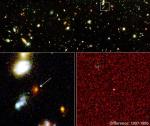 Distant Supernova Dark Energy
4.04.2001
Light from a star that exploded over 10 billion light-years away is revealed in the panel at the lower right, a cosmic snapshot of the most distant supernova. The ancient stellar detonation was detected...
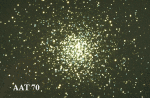 Globular Cluster M5
19.10.1995
The globular cluster M5, pictured above, contains roughly 100,000 stars. These stars formed together and are gravitationally bound. Stars orbit the center of the cluster, and the cluster orbits the center of our Galaxy. So far, about 160 globular clusters are known to exist in a roughly spherical halo around the Galactic center.
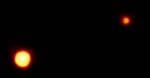 Pluto: The Frozen Planet
13.02.1999
This portrait of Pluto and its companion Charon was taken by the Hubble Space Telescope in 1994. Pluto is usually the most distant planet from the Sun but because of its eccentric orbit Pluto crossed inside of Neptune's orbit in 1979.
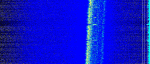 An Anomalous SETI Signal
30.03.1999
No one knows for sure what caused this signal. The bright colors on the blue background indicate that an anomalous signal was received here on Earth by a radio telescope involved in a Search for Extraterrestrial Intelligence (SETI). A search for these signals is ongoing by several groups including volunteer members of the SETI League.
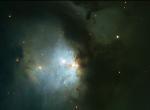 Reflection Nebula M78
24.04.2000
An eerie blue glow and ominous columns of dark dust highlight M78, a bright reflection nebula in the constellation of Orion. The dust not only absorbs light, but also reflects the light of several bright blue stars that formed recently in the nebula.
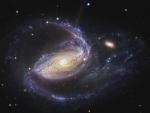 In the Arms of NGC 1097
1.12.2006
A smaller companion seems wrapped in the spiral arms of enigmatic galaxy NGC 1097. This amazingly deep image of the peculiar spiral system, also known as Arp 77, actually combines data from two telescopes, one in the northern and one in the southern hemisphere of planet Earth.
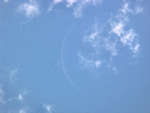 Crescent Venus and Moon
16.05.2010
There's something behind these clouds. Those faint graceful arcs, upon inspection, are actually far, far in the distance. They are the Earth's Moon and the planet Venus. Both the Moon and Venus are bright enough to be seen during the day, and both are quite capable of showing a crescent phase.
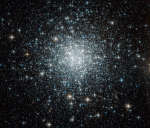 Globular Star Cluster NGC 6934
9.10.2010
Globlular star clusters roam the halo of our Milky Way Galaxy. Gravitationally bound, these spherical groupings of typically several hundred thousand stars are ancient, older than the stars of the galactic disk. In fact...
|
January February |
|||||||||||||||||||||||||||||||||||||||||||||||||