
|
You entered: telescope
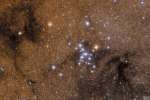 M7: Open Star Cluster in Scorpius
7.01.2014
M7 is one of the most prominent open clusters of stars on the sky. The cluster, dominated by bright blue stars, can be seen with the naked eye in a dark sky in the tail of the constellation of the Scorpion (Scorpius).
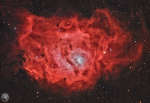 The Lagoon Nebula is Stars, Gas, and Dust
12.11.2018
The majestic Lagoon Nebula is filled with hot gas and the home for many young stars. Spanning 100 light years across while lying only about 5000 light years distant, the Lagoon Nebula is so big and bright that it can be seen without a telescope toward the constellation of the Archer (Sagittarius).
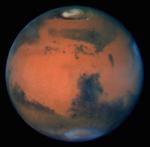 The Weather on Mars
24.03.1997
Would Mars be a nice place to visit? Sometimes. Much of Mars undergoes severe changes in climate during its orbit around the Sun, ranging from extreme cold to temperatures enjoyable by humans. But Mars...
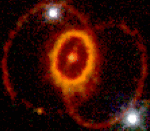 The Mysterious Rings of Supernova 1987a
5.07.1996
What's causing those odd rings in supernova 1987a? In 1987, the brightest supernova in recent history occurred in the Large Magellanic Clouds. At the center of the picture is an object central to the remains of the violent stellar explosion.
 A Cerro Tololo Sky
9.11.2002
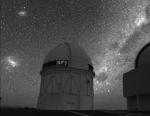
High atop a Chilean mountain lies one of the premier observatories of the southern sky: the Cerro Tololo Inter-American Observatory (CTIO). Pictured above is the dome surrounding one of the site's best known instruments, the 4-meter Blanco Telescope.
 Saturns Rings Seen Sideways
18.10.1998
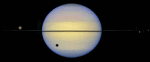
Saturn's rings are actually very thin. This picture from the Hubble Space Telescope was taken on August 6, 1995 when the rings lined up sideways as seen from Earth. Saturn's largest moon Titan is seen on the left, and Titan's shadow can be seen on Saturn's cloud tops!
 A Lonely Neutron Star
28.11.1998
How massive can a star get without imploding into a black hole? These limits are being tested by the discovery of a lone neutron star in space. Observations by the Hubble Space Telescope have...
 In the Center of 30 Doradus
21.02.1999
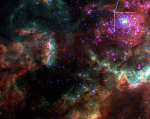
In the center of 30 Doradus lies a huge cluster of the largest, hottest, most massive stars known. The center of this cluster, known as R136, is boxed in the upper right portion of the above picture.
 The Universe Evolves
5.09.1999
Scroll right and watch the universe evolve. Above is a computer simulation depicting the evolution of our entire universe. On the far left is a slice of the universe soon after the Big Bang - over 10 billion years ago.
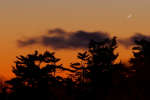 A New Year s Crescent
1.01.2014
That's not the young crescent Moon poised above the western horizon at sunset. Instead it's Venus in a crescent phase, captured with a long telephoto lens from Quebec City, Canada, planet Earth on a chilly December 30th evening. The very bright celestial beacon is droping lower into the evening twilight every day.
|
January February March April May |
|||||||||||||||||||||||||||||||||||||||||||||||||