
|
You entered: sky
 APOD: 2025 August 3 Б Milky Way and Exploding Meteor
3.08.2025
In about a week the Perseid Meteor Shower will reach its maximum. Grains of icy rock will streak across the sky as they evaporate during entry into Earth's atmosphere. These grains were shed from Comet Swift-Tuttle.
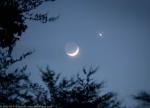 Love and War by Moonlight
24.05.2002
Venus, named for the Roman goddess of love, and Mars, the war god's namesake, approach each other by moonlight in this lovely sky view recorded on May 14th from Dunkirk, Maryland, USA.
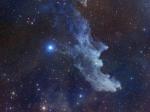 IC 2118: The Witch Head Nebula
11.12.2006
Double, double toil and trouble; Fire burn, and cauldron bubble -- maybe Macbeth should have consulted the Witch Head Nebula. This suggestively shaped reflection nebula is associated with the bright star Rigel in the constellation Orion.
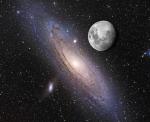 Moon Over Andromeda
28.12.2006
The Great Spiral Galaxy in Andromeda (aka M31), a mere 2.5 million light-years distant, is the closest large spiral to our own Milky Way. Andromeda is visible to the unaided eye as a small...
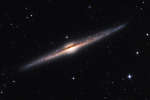 NGC 4565: Galaxy on the Edge
28.04.2009
Is our Galaxy this thin? We believe so. Magnificent spiral galaxy NGC 4565 is likely similar to our own spiral galaxy, but viewed edge-on from far away. Also known as the Needle Galaxy...
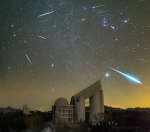 Geminid Meteors over Xinglong Observatory
13.12.2020
Where do Geminid meteors come from? In terms of location on the sky, as the featured image composite beautifully demonstrates, the sand-sized bits of rock that create the streaks of the Geminids meteor shower appear to flow out from the constellation of Gemini.
 APOD: 2023 September 18 Б The Red Sprite and the Tree
18.09.2023
The sprite and tree could hardly be more different. To start, the red sprite is an unusual form of lightning, while the tree is a common plant. The sprite is far away -- high in Earth's atmosphere, while the tree is nearby -- only about a football field away.
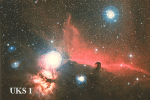 Orion's Horsehead Nebula
25.09.1995
The black indentation to the red emission nebula seen just to the right of center of the above photograph is one of the most famous features in any nebulae on the sky. Because of its shape, it is known as the Horsehead Nebula.
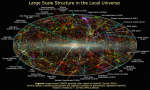 The Universe Nearby
11.12.2007
What does the universe nearby look like? This plot shows over one and a half million of the brightest stars and galaxies in the nearby universe detected by the Two Micron All Sky Survey (2MASS) in infrared light.
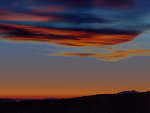 Mercury on the Horizon
27.01.2008
Have you ever seen the planet Mercury? Because Mercury orbits so close to the Sun, it never wanders far from the Sun in Earth's sky. If trailing the Sun, Mercury will be visible low on the horizon for only a short while after sunset.
|
January February March April May June July August September October |
|||||||||||||||||||||||||||||||||||||||||||||||||