
|
You entered: sky
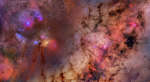 Scorpius Enhanced
16.06.2021
If Scorpius looked this good to the unaided eye, humans might remember it better. Scorpius more typically appears as a few bright stars in a well-known but rarely pointed out zodiacal constellation. To get a spectacular image like this, though, one needs a good camera, a dark sky, and some sophisticated image processing.
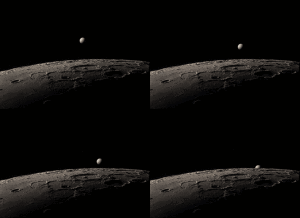 Lunar Occultation of Venus
2.06.2022
On May 27 Venus rose as the morning star, near the waning crescent Moon in a predawn sky already full of planets. It was close on the sky to the Moon's crescent and a conjunction of the second an third brightest celestial beacons were enjoyed by skygazers around the world.
 APOD: 2025 May 27 Б Zeta and Rho Ophiuchi with Milky Way
27.05.2025
Behold one of the most photogenic regions of the night sky, captured impressively. Featured, the band of our Milky Way Galaxy runs diagonally along the bottom-left corner, while the colorful Rho Ophiuchi cloud complex is visible just right of center and the large red circular Zeta Ophiuchi Nebula appears near the top.
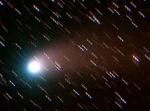 Comet McNaught Hartley
14.03.2001
Outbound and climbing above the plane of our solar system, comet McNaught-Hartley (C/1999 T1) is presently soaring through northern skies. This telescopic picture, a composite of many 30 second exposures made through three color filters, recorded the delicate colors in its diminutive coma and faint tail on February 26th.
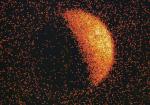 X-Ray Moon
4.10.2003
This x-ray image of the Moon was made by the orbiting ROSAT (Röntgensatellit) Observatory in 1990. In this digital picture, pixel brightness corresponds to x-ray intensity. Consider the image in three parts: the bright hemisphere of the x-ray moon, the darker half of the moon, and the x-ray sky background.
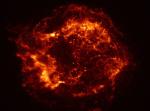 Chandras First Light: Cassiopeia A
27.08.1999
Cosmic wreckage from the detonation of a massive star is the subject of this official first image from NASA's Chandra X-ray Observatory. The supernova remnant, known as Cassiopeia A, was produced when a star exploded around 300 years ago in this northern sky constellation.
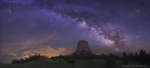 The Milky Way Over Devils Tower
29.07.2009
Was Devil's Tower once an explosive volcano? Famous for its appearance in films such as Close Encounters, the origin of Devil's Tower in Wyoming, USA is still debated, with a leading hypothesis holding that it is a hardened lava plume that probably never reached the surface to become a volcano.
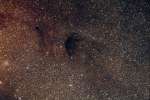 Dim World, Dark Nebula
8.07.2010
Dim, distant, dwarf planet Pluto can be hard to spot, especially in recent months as it wanders through the crowded starfields of Sagittarius and the central Milky Way. But fortunately for backyard Pluto hunters, it crossed in front of a dark nebula in early July.
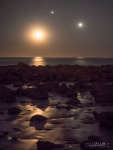 Triple Conjunction Over Galician National Park
24.06.2015
What are those bright objects hovering over the horizon? Planets -- and the Moon. First out, the horizon featured is a shoreline of the Atlantic Ocean that occurs at the Galicia National Park in northern Spain. Next furthest out, on the left, is the Moon.
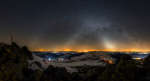 Arches of Spring
29.04.2017
Two luminous arches stretched across the dome of the sky on this northern spring night. After sunset on March 29, the mountain view panorama was captured in 57 exposures from Chopok peak in central Slovakia at an altitude of about 2,000 meters.
|
January February March April May June July August September October |
|||||||||||||||||||||||||||||||||||||||||||||||||