
|
You entered: sky
 The Great Globular Cluster in Hercules
26.09.2024
In 1716, English astronomer Edmond Halley noted, "This is but a little Patch, but it shows itself to the naked Eye, when the Sky is serene and the Moon absent." Of course...
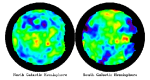 COBE Hotspots: The Oldest Structures Known
6.02.1996
Above are two microwave images of the sky, looking north and south of our galaxy's equator, based on data from NASA's COBE satellite. After computer processing to remove contributions from nearby objects and the effects of the earth's motion, they show "spots".
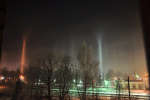 Unusual Light Pillars Over Latvia
12.01.2009
What's happening over that town? Close inspection shows these strange columns of light occur over bright lights, and so likely involve falling ice crystals reflecting back these lights. The reason why these pillars...
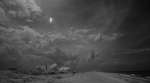 SpaceX Demo-2 Launch
13.06.2020
Clouds are white but the sky is dark in this snapshot of Launch Complex 39A at the Kennedy Space Center. The dramatic daytime sky is partly due to the black and white photo captured with a digital camera at near-infrared wavelengths. Taken at 3:22 p.m.
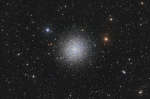 M13: The Great Globular Cluster in Hercules
20.05.2021
In 1716, English astronomer Edmond Halley noted, "This is but a little Patch, but it shews itself to the naked Eye, when the Sky is serene and the Moon absent." Of course...
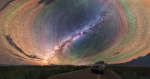 Colorful Airglow Bands Surround Milky Way
13.03.2022
Why would the sky glow like a giant repeating rainbow? Airglow. Now air glows all of the time, but it is usually hard to see. A disturbance however -- like an approaching storm -- may cause noticeable rippling in the Earth's atmosphere.
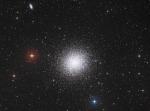 M13: The Great Globular Cluster in Hercules
15.11.2007
M13 is modestly recognized as the Great Globular Cluster in Hercules. A system of stars numbering in the hundreds of thousands, it is one of the brightest globular star clusters in the northern sky.
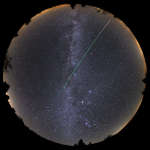 Night of the Long Leonid
22.11.2012
A cosmic grain of sand left the long and colorful trail across this all-sky view. Its grazing impact with planet Earth's atmosphere began at 71 kilometers per second. With the Milky Way stretching...
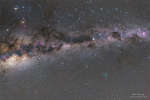 Close Comet and the Milky Way
25.03.2016
Comet 252P/Linear's lovely greenish coma is easy to spot in this expansive southern skyscape. Visible to the naked eye from the dark site near Flinders, Victoria, Australia, the comet appears tailless. Still, its surprisingly bright coma spans about 1 degree, posed here below the nebulae, stars, and dark rifts of the Milky Way.
 Mars in Taurus
4.03.2021
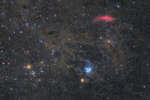
You can spot Mars in the evening sky tonight. Now home to the Perseverance rover, the Red Planet is presently wandering through the constellation Taurus, close on the sky to the Seven Sisters or Pleiades star cluster.
|
January February March April May June July August September October |
|||||||||||||||||||||||||||||||||||||||||||||||||