
|
You entered: sky
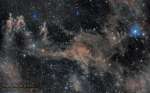 Stardust in Aries
9.12.2017
This composition in stardust covers over 8 degrees on the northern sky. The mosaicked field of view is west of the familiar Pleiades star cluster, toward the zodiacal constellation Aries and the plane of our Milky Way Galaxy.
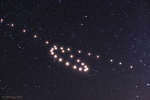 Mars in the Loop
8.11.2018
This composite of images spaced some 5 to 9 days apart, from late April (bottom right) through November 5 (top left), traces the retrograde motion of ruddy-colored Mars through planet Earth's night sky.
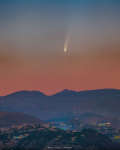 Comet NEOWISE over Lebanon
7.07.2020
A comet has suddenly become visible to the unaided eye. Comet C/2020 F3 (NEOWISE) was discovered in late March and brightened as it reached its closest approach to the Sun, inside the orbit of Mercury, late last week.
 APOD: 2024 April 29 Б Comet, Planet, Moon
29.04.2024
Three bright objects satisfied seasoned stargazers of the western sky just after sunset earlier this month. The most familiar was the Moon, seen on the upper left in a crescent phase. The rest of the Moon was faintly visible by sunlight first reflected by the Earth.
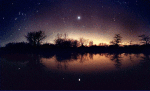 Hyakutake, Venus, Orion, and Pond
18.04.1996
Can you find Comet Hyakutake in the above picture? In this gorgeous photo, the starry night sky of April 9th is pictured with its new comet visitor. In the foreground is a pond with the lights of Kansas City, Missouri on the western horizon. On the upper left, the constellation of Orion is visible.
 Planet Near a Galaxy Core
5.05.1996
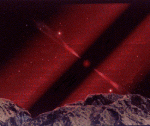
What would the night sky look like if you lived on a planet near the center of a galaxy? Now imagine that this galaxy houses a black hole billions of times more massive than a star. From this spectacular vantage point, the sky might look like the above illustration.
 Zodiacal Light Vs Milky Way
12.02.2009
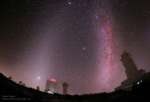
Two fundamental planes of planet Earth's sky compete for attention in this remarkable wide-angle vista, recorded on January 23rd. Arcing above the horizon and into the night at the left is a beautiful band of Zodiacal Light - sunlight scattered by dust in the solar system's ecliptic plane.
 The Hunter s Stars
19.01.2012
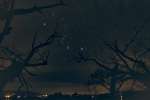
Begirt with many a blazing star, Orion, the Hunter, is one of the most easily recognizable constellations. In this night skyscape from January 15, the hunter's stars rise in the northern hemisphere...
 Antares Rocket Launch
21.09.2013
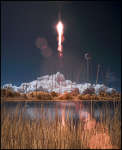
The sky looks dark in this scene from the Mid-Atlantic Regional Spaceport (MARS) at NASA Wallops Flight Facility, Virginia. Captured on Wednesday, September 18, an Orbital Sciences Corporation Antares rocket is leaving launch pad-0A with the Cygnus cargo spacecraft aboard.
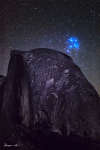 Pleiades over Half Dome
19.07.2022
Stars come in bunches. The most famous bunch of stars on the sky is the Pleiades, a bright cluster that can be easily seen with the unaided eye. The Pleiades lies only about 450 light years away, formed about 100 million years ago, and will likely last about another 250 million years.
|
January February March April May June July August September October |
|||||||||||||||||||||||||||||||||||||||||||||||||