
|
You entered: sky
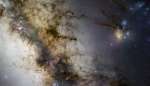 Gigagalaxy Zoom: Galactic Center
25.09.2009
From Sagittarius to Scorpius, the central Milky Way is a truly beautiful part of planet Earth's night sky. The gorgeous region is captured here, an expansive gigapixel mosaic of 52 fields spanning 34 by 20 degrees in 1200 individual images and 200 hours of exposure time.
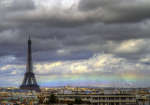 A Horizon Rainbow in Paris
27.03.2013
Why is this horizon so colorful? Because, opposite the Sun, it is raining. What is pictured above is actually just a common rainbow. It's uncommon appearance is caused by the Sun being unusually high in the sky during the rainbow's creation.
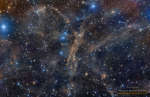 A Dust Angel Nebula
28.04.2016
The combined light of stars along the Milky Way are reflected by these cosmic dust clouds that soar some 300 light-years or so above the plane of our galaxy. Dubbed the Angel Nebula, the faint apparition is part of an expansive complex of dim and relatively unexplored, diffuse molecular clouds.
 Orion over the Austrian Alps
23.01.2019
Do you recognize this constellation? Through the icicles and past the mountains is Orion, one of the most identifiable star groupings on the sky and an icon familiar to humanity for over 30,000 years.
 APOD: 2024 June 11 Б Colorful Stars and Clouds near Rho Ophiuchi
11.06.2024
Why is the sky near Antares and Rho Ophiuchi so colorful, yet dusty? The colors result from a mixture of objects and processes. Fine dust -- illuminated by starlight -- produces blue reflection nebulae. Gaseous clouds whose atoms are excited by ultraviolet starlight produce reddish emission nebulae. Backlit dust clouds block starlight and so appear dark.
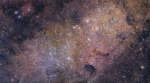 APOD: 2026 July 11 Б Messier 24: Sagittarius Star Cloud
11.07.2026
Unlike most entries in Charles Messier's famous catalog of deep sky objects, M24 is not a bright galaxy, star cluster, or nebula. It's a gap in nearby, obscuring interstellar dust clouds that allows a view of the distant stars in the Sagittarius spiral arm of our Milky Way galaxy.
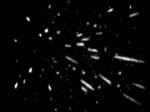 Quadrantids: Meteors in Perspective
26.01.1996
Meteor showers are caused by streams of solid particles, dust size and larger, moving as a group through space. In many cases, the orbits of these meteor streams can be identified with the dust tails of comets.
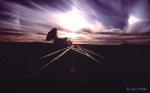 Sundogs over the VLA
23.08.1999
What if you woke up one morning and saw more than one Sun in the sky? Most probably, you would be seeing sundogs, extra-images of the Sun created by falling ice-crystals in the Earth's atmosphere. As water freezes in the atmosphere, small, flat, six-sided, ice crystals might be formed.
 Mars in a Manger
30.04.2010
At opposition in late January, Mars shone very brightly in planet Earth's night sky, among the stars of the constellation Cancer the Crab. Since then the Red Planet has been fading, but still lingers in Cancer during April and May.
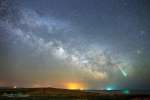 Meteor in the Milky Way
23.04.2015
Earth's April showers include the Lyrid Meteor Shower, observed for more than 2,000 years when the planet makes its annual passage through the dust stream of long-period Comet Thatcher. A grain...
|
January February March April May June July August September October |
|||||||||||||||||||||||||||||||||||||||||||||||||