
|
You entered: sky
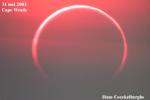 Ring of Fire from Cape Wrath
5.06.2003
If the Moon's apparent diameter is not quite large enough to cover the Sun during a solar eclipse, an annular eclipse can be the result -- a spectacle of silhouetted Moon surrounded by a solar "ring of fire".
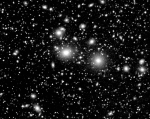 The Perseus Cluster of Galaxies
26.04.1997
Here is one of the largest objects that anyone will ever see on the sky. Each of the fuzzy blobs in the above picture is a galaxy, together making up the Perseus Cluster, one of the closest clusters of galaxies.
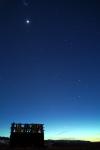 Mercury and Venus in the West
2.04.2004
Doing their part in the ongoing dance of the planets, Mercury and Venus both reached their greatest elongation or maximum apparent distance from the Sun only a few days ago, on March 29th. Eager...
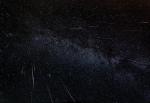 Raining Perseids
6.08.2005
Comet dust rained down on planet Earth last August, streaking through dark skies in the annual Perseid meteor shower. So, while enjoying the anticipated space weather, astronomer Fred Bruenjes recorded a series of many 30 second long exposures spanning about six hours on the night of August 11/12 using a wide angle lens.
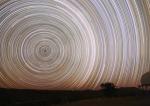 11 Hour Star Trails
15.09.2006
Fix your camera to a tripod, lock the shutter open, and you can make an image of star trails - graceful concentric arcs traced by the stars as planet Earth rotates on its axis. Of course, the length of the star trails will depend on the exposure time.
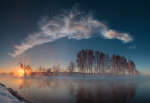 Miass River Sunrise
2.03.2013
Each day on planet Earth can have a serene beginning at sunrise as the sky gently grows bright over a golden eastern horizon. This sunrise panorama seems to show such a moment on the winter morning of February 15.
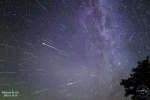 Perseid Meteors Over China
21.08.2013
Comet dust rained down on planet Earth earlier this month, streaking through dark skies in the annual Perseid meteor shower. While enjoying the anticipated space weather above Zhangbei Prairie, Hebei Province, China, astronomer Xiang...
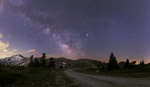 Milky Way and Planets Near Opposition
21.05.2016
In this early May night skyscape, a mountain road near Bursa, Turkey seems to lead toward bright planets Mars and Saturn and the center of our Milky Way Galaxy, a direction nearly opposite the Sun in planet Earth's sky.
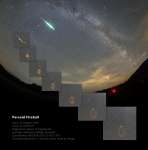 Perseid Fireball and Persistent Train
17.08.2018
Before local midnight on August 12, this brilliant Perseid meteor flashed above the Poloniny Dark Sky Park, Slovakia, planet Earth. Streaking beside the summer Milky Way, its initial color is likely due to the shower meteor's characteristically high speed.
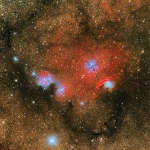 NGC 6559: East of the Lagoon
7.10.2021
Slide your telescope just east of the Lagoon Nebula to find this alluring field of view in the rich starfields of the constellation Sagittarius toward the central Milky Way. Of course the Lagoon nebula is also known as M8, the eighth object listed in Charles Messier's famous catalog of bright nebulae and star clusters.
|
January February March April May June July August September October |
|||||||||||||||||||||||||||||||||||||||||||||||||