
|
You entered: sky
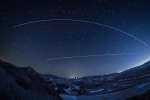 Space Stations in Low Earth Orbit
7.01.2023
On January 3, two space stations already illuminated by sunlight in low Earth orbit crossed this dark predawn sky. Moving west to east (left to right) across the composited timelapse image China's Tiangong Space Station traced the upper trail captured more than an hour before the local sunrise.
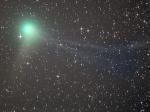 Announcing Comet Machholz
13.12.2004
A comet discovered only this summer is brightening quickly and already visible to the unaided eye. Comet C/2004 Q2 (Machholz) is currently best visible in Earth's Southern Hemisphere where some observers report it brighter than magnitude 5. The comet is moving rapidly to northern skies and should continue to brighten until early January.
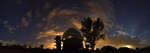 Moon Rays over Byurakan Observatory
26.09.2008
On September 7th, the first quarter Moon and passing clouds contributed to a dramatic night sky over the Byurakan Astrophysical Observatory. This panoramic view begins at the left looking toward the eastern horizon and the rising stars of the constellation Perseus.
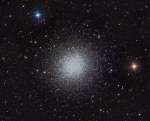 M13: The Great Globular Cluster in Hercules
14.06.2012
In 1716, English astronomer Edmond Halley noted, "This is but a little Patch, but it shews itself to the naked Eye, when the Sky is serene and the Moon absent." Of course, M13 is now modestly recognized as the Great Globular Cluster in Hercules, one of the brightest globular star clusters in the northern sky.
 High Redshift Quasars
11.12.1998
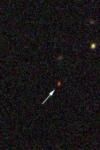
Each red speck indicated above is a powerful quasar estimated to be over 100 times brighter than a galaxy. Yet in these Sloan Digital Sky Survey discovery images the quasars appear faint because they are extremely distant.
 Stars and the Solstice Sun
21.06.2007
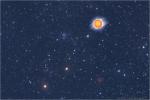
If you could turn off the atmosphere's ability to scatter overwhelming sunlight, today's daytime sky might look something like this ... with the Sun surrounded by the stars of the constellations Taurus and Gemini. Of course, today is the Solstice.
 Night Shinings
2.07.2008
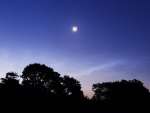
In the early morning hours of June 30th, ghostly clouds hovered in the east in this view of near dawn skies over western France. The noctilucent or night-shining clouds lie near the edge of space, reflecting sunlight from about 80 kilometers above Earth's surface.
 Unusual Light Pillars over Latvia
27.12.2014
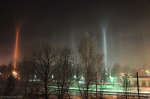
What's happening over that town? Close inspection shows these strange columns of light occur over bright lights, and so likely are light pillars that involve falling ice crystals reflecting back these lights. The above image and several similar images were taken with a standard digital camera in Sigulda, Latvia in late 2009.
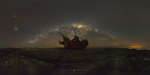 Milky Way over Shipwreck
30.11.2016
What happened to this ship? It was carried aground by a giant storm that struck the coast of Argentina in 2002. The pictured abandoned boat, dubbed Naufragio del Chubasco, wrecked near the nearly abandoned town of Cabo Raso (population: 1). The rusting ship provides a picturesque but perhaps creepy foreground for the beautiful sky above.
 The Great Globular Cluster in Hercules
1.09.2023
In 1716, English astronomer Edmond Halley noted, "This is but a little Patch, but it shows itself to the naked Eye, when the Sky is serene and the Moon absent." Of course...
|
January February March April May June July August September October |
|||||||||||||||||||||||||||||||||||||||||||||||||