
|
You entered: rotation
 APOD: 2025 September 14 Б Planets of the Solar System: Tilts and Spins
14.09.2025
How does your favorite planet spin? Does it spin rapidly around a nearly vertical axis, or horizontally, or backwards? The featured video animates NASA images of all eight planets in our Solar System to show them spinning side-by-side for an easy comparison.
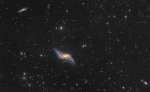 Polar Ring Galaxy NGC 660
3.12.2009
NGC 660 lies near the center of this intriguing field of galaxies swimming within the boundaries of the constellation Pisces. Over 20 million light-years away, its peculiar appearance marks it as a polar ring galaxy.
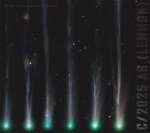 APOD: 2025 October 6 Б The Changing Ion Tail of Comet Lemmon
6.10.2025
How does a comet tail change? It depends on the comet. The ion tail of Comet C/2025 A6 (Lemmon) has been changing markedly, as detailed in the featured image sequenced over six days between September 25 and October 4 (left to right) from Texas, USA.
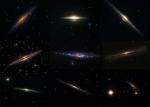 Spirals On Edge
10.05.2001
Spiral galaxies viewed face-on display a grand design, with graceful spiral arms traced by bright star clusters and glowing stellar nurseries. When seen edge-on, their appearance is very different but no less striking as their central regions bulge and dark cosmic dust lanes appear silhouetted against starlight from flattened galactic disks.
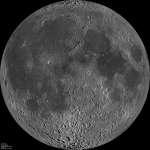 Lunar Nearside
3.03.2011
About 1,300 images from the Lunar Reconnaissance Orbiter spacecraft's wide angle camera were used to compose this spectacular view of a familiar face - the lunar nearside. But why is there a lunar nearside? The Moon rotates on its axis and orbits the Earth at the same rate, about once every 28 days.
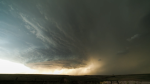 A Supercell Thunderstorm Over Texas
18.06.2013
Is that a cloud or an alien spaceship? It's an unusual and sometimes dangerous type of thunderstorm cloud called a supercell. Supercells may spawn damaging tornados, hail, downbursts of air, or drenching rain. Or they may just look impressive.
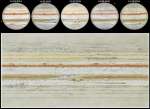 Jupiter Unplugged
2.03.2012
Five hand drawn sketches of Jupiter were used to create this beautifully detailed flat map of the ruling gas giant's turbulent cloud tops. Made with colored pencils at the eyepiece of a 16 inch diameter telescope, the original drawings are about 5 inches (12.5 cm) in diameter.
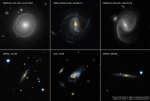 Spiral Galaxies Spinning Super Fast
5.11.2019
Why are these galaxies spinning so fast? If you estimated each spiral's mass by how much light it emits, their fast rotations should break them apart. The leading hypothesis as to why these galaxies don't break apart is dark matter -- mass so dark we can't see it.
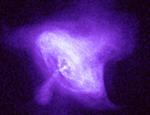 The Crab Nebula in X Rays
29.09.1999
Why does the Crab Nebula still glow? In the year 1054 A.D. a supernova was observed that left a nebula that even today glows brightly in every color possible, across the entire electromagnetic spectrum. At the nebula's center is an ultra-dense neutron star that rotates 30 times a second.
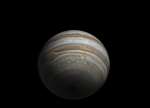 Approaching Jupiter
23.05.2017
What would it look like to approach Jupiter? To help answer this, a team of 91 amateur astrophotographers took over 1,000 pictures of Jupiter from the Earth with the resulting images aligned and digitally merged into the featured time-lapse video. Image taking began in 2014 December and lasted just over three months.
|
January February March April May June July August September |
|||||||||||||||||||||||||||||||||||||||||||||||||