
|
You entered: rotation
 Venus at Night in Infrared from Akatsuki
29.01.2018
Why is Venus so different from Earth? To help find out, Japan launched the robotic Akatsuki spacecraft which entered orbit around Venus late in 2015 after an unplanned five-year adventure around the inner Solar System.
 Large Sunspot Group AR 9393
11.04.2001
The largest sunspot group of the past ten years crossed the surface of the Sun late last month and early this month. The group was designated Active Region 9393 as it was the 9393rd region identified since counting officially began in 1973.
 Active Region 1002 on an Unusually Quiet Sun
24.09.2008
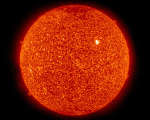
Why has the Sun been so quiet recently? No one is sure. Our Sun has shown few active regions -- that house even fewer associated sunspots -- for over a year now, and such a period of relative calm is quite unusual.
 Julius Caesar and Leap Days
28.02.2024
In 46 BC Julius Caesar reformed the calendar system. Based on advice by astronomer Sosigenes of Alexandria, the Julian calendar included one leap day every four years to account for the fact that an Earth year is slightly more than 365 days long.
 Galaxies and the South Celestial Pole
31.12.2020
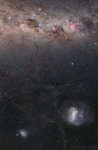
The South Celestial Pole is easy to spot in star trail images of the southern sky. The extension of Earth's axis of rotation to the south, it's at the center of all the southern star trail arcs.
 Far Side of the Sun
3.05.2001
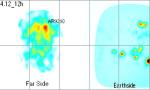
You may think it's impossible to see through the Sun, but maps of the Sun's far side are now made routinely by instruments on board the sun-staring SOHO spacecraft. This is one such map from April 12.
 Julius Caesar and Leap Days
28.02.1996
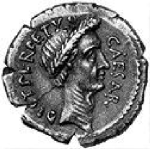
Today, February 29th, is a leap day - a relatively rare occurrence. Advised by Alexandrian astronomer Sosigenes, Roman dictator Julius Caesar, pictured above in a self-decreed minted coin, created a calender system in 46 BC that contained one leap day every four years.
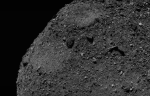 Tagging Bennu: The Movie
2.11.2020
This is what it looks like to punch an asteroid. Last month, NASA's robotic spacecraft OSIRIS-REx descended toward, thumped into, and then quickly moved away from the small near-Earth asteroid 101955 Bennu. The featured video depicts the Touch-And-Go (TAG) sampling event over a three-hour period.
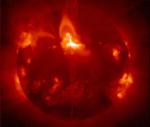 Active Regions, CMEs, and X Class Flares
8.06.2000
Space Weather forcasters are predicting major storm conditions over the next few days as the active Sun has produced at least three strong flares and a large coronal mass ejection (CME) since Tuesday, June 6th.
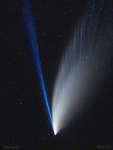 APOD: 2020 July 22 Б The Structured Tails of Comet NEOWISE
21.07.2020
What is creating the structure in Comet NEOWISE's tails? Of the two tails evident, the blue ion tail on the left points directly away from the Sun and is pushed out by the flowing and charged solar wind.
|
January February March April May June July August September |
|||||||||||||||||||||||||||||||||||||||||||||||||