
|
You entered: rotation
 X Ray Mystery in RCW 38
27.12.2002
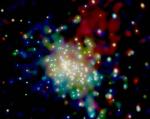
A mere 6,000 light-years distant and sailing through the constellation Vela, star cluster RCW 38 is full of powerful stars. It's no surprise that these stars, only a million years young with hot outer atmospheres, appear as point-like x-ray sources dotting this x-ray image from the orbiting Chandra Observatory.
 The Milky Way Over Ontario
29.07.2008
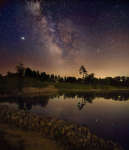
Sometimes, after your eyes adapt to the dark, a spectacular sky appears. Such was the case earlier this month over Ontario, Canada, when part of a spectacular sky also became visible in a reflection off a lake.
 Saturns Northern Hexagon
5.07.2020
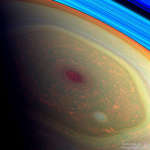
Why would clouds form a hexagon on Saturn? Nobody is sure. Originally discovered during the Voyager flybys of Saturn in the 1980s, nobody has ever seen anything like it anywhere else in the Solar System.
 X Ray Mystery in RCW 38
8.01.2005
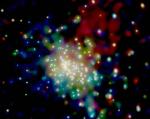
A mere 6,000 light-years distant and sailing through the constellation Vela, star cluster RCW 38 is full of powerful stars. It's no surprise that these stars, only a million years young with hot outer atmospheres, appear as point-like x-ray sources dotting this x-ray image from the orbiting Chandra Observatory.
 Namibian Nights
4.02.2013
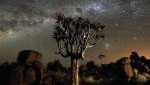
Namibia has some of the darkest nights visible from any continent. It is therefore home to some of the more spectacular skyscapes, a few of which have been captured in the above time-lapse video.
 Starburst Galaxy M94 from Hubble
1.12.2019
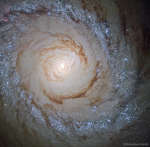
Why does this galaxy have a ring of bright blue stars? Beautiful island universe Messier 94 lies a mere 15 million light-years distant in the northern constellation of the Hunting Dogs (Canes Venatici).
 APOD: 2023 May 31 Б Simulation: A Disk Galaxy Forms
31.05.2023
How did we get here? We know that we live on a planet orbiting a star orbiting a galaxy, but how did all of this form? Since our universe moves too slowly to watch, faster-moving computer simulations are created to help find out.
 APOD: 2024 October 20 Б Dark Matter in a Simulated Universe
20.10.2024
Is our universe haunted? It might look that way on this dark matter map. The gravity of unseen dark matter is the leading explanation for why galaxies rotate so fast, why galaxies orbit clusters...
 Magnetar
27.05.1998
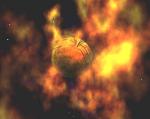
What do you call a neutron star with a super-strong magnetic field? You guessed it ... a Magnetar. Imagine a star with more mass than the sun, the density of a neutron, and a magnetic field about a thousand trillion (a one followed by 15 zeroes) times stronger than Earth's.
 Flying Past Pluto
6.10.2015
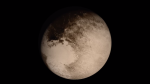
What would it look like to fly past Pluto? The robotic New Horizons spacecraft did just this in late July and continues to return stunning pictures of the dwarf planet. Some well-chosen flyby images have now been digitally sequenced to create the featured video.
|
January February March April May June July August September |
|||||||||||||||||||||||||||||||||||||||||||||||||