
|
You entered: rotation
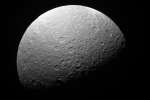 Ancient Craters of Southern Rhea
13.05.2008
Saturn's ragged moon Rhea has one of the oldest surfaces known. Estimated as changing little in the past billion years, Rhea shows craters so old they no longer appear round their edges have become compromised by more recent cratering.
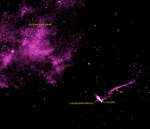 The Long Jet of the Lighthouse Nebula
21.02.2014
The Lighthouse nebula was formed by the wind of a pulsar, a rapidly rotating, magnetized neutron star, as it speeds through the interstellar medium at over 1,000 kilometers per second. Some...
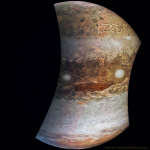 A Face in the Clouds of Jupiter from Juno
8.06.2021
What do you see in the clouds of Jupiter? On the largest scale, circling the planet, Jupiter has alternating light zones and reddish-brown belts. Rising zone gas, mostly hydrogen and helium, usually swirls around regions of high pressure. Conversely, falling belt gas usually whirls around regions of low pressure, like cyclones and hurricanes on Earth.
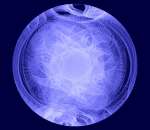 Fermi Epicyles: The Vela Pulsar s Path
4.05.2012
Exploring the cosmos at extreme energies, the Fermi Gamma-ray Space Telescope orbits planet Earth every 95 minutes. By design, it rocks to the north and then to the south on alternate orbits in order to survey the sky with its Large Area Telescope (LAT).
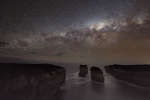 A Milky Way Shadow at Loch Ard Gorge
23.08.2010
Have you ever seen the Milky Way's glow create shadows? To do so, conditions need to be just right. First and foremost, the sky must be relatively clear of clouds so that the long band of the Milky Way's central disk can be seen.
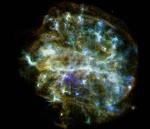 Elements in the Aftermath
26.10.2001
Massive stars spend their brief lives furiously burning nuclear fuel. Through fusion at extreme temperatures and densities surrounding the stellar core, nuclei of light elements like Hydrogen and Helium are combined to heavier elements like Carbon, Oxygen, etc. in a progression which ends with Iron.
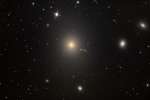 M87: Elliptical Galaxy with Jet
20.05.2010
In spiral galaxies, majestic winding arms of young stars, gas, and dust rotate in a flat disk around a bulging galactic nucleus. But elliptical galaxies seem to be simpler. Lacking gas and dust to form new stars, their randomly swarming older stars, give them an ellipsoidal (egg-like) shape. Still, elliptical galaxies can be very large.
 SDO s Multiwavelength Sun
21.12.2013
Today, the solstice is at 17:11 Universal Time, the Sun reaching the southernmost declination in its yearly journey through planet Earth's sky. The December solstice marks the astronomical beginning of winter in the northern hemisphere and summer in the south.
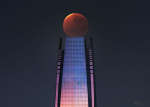 Lunar Eclipse over a Skyscraper
22.11.2021
Why is the Moon on top of this building? Planning. It took the astrophotographer careful planning -- including figuring out exactly where to place the camera and exactly when to take the shot -- to create this striking superposition.
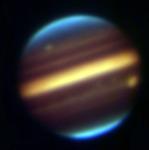 WIRO at Jupiter
13.03.2003
Gazing out over the mountaintops from the Wyoming InfraRed Observatory (WIRO), astronomers recently recorded this bizarre looking image of the solar system's ruling planet, gas giant Jupiter. The false-color picture is a composite...
|
January February March April May June July August September |
|||||||||||||||||||||||||||||||||||||||||||||||||