
|
You entered: rotation
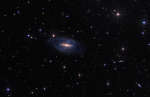 Polar Ring Galaxy NGC 2685
14.03.2014
NGC 2685 is a confirmed polar ring galaxy - a rare type of galaxy with stars, gas and dust orbiting in rings perpendicular to the plane of a flat galactic disk. The bizarre configuration could...
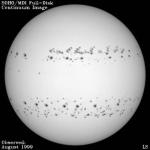 Follow The Spots
21.10.1999
The Sun rotates on its axis about once every 27 days. How can you tell? Just follow the sunspots. This composite picture was constructed from solar images recorded daily by the MDI instrument on board the space-based SOlar and Heliospheric Observatory (SOHO).
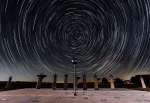 Star Trails and the Bracewell Radio Sundial
13.07.2018
Sundials use the location of a shadow to measure the Earth's rotation and indicate the time of day. So it's fitting that this sundial, at the Very Large Array Radio Telescope Observatory in New Mexico, commemorates the history of radio astronomy and radio astronomy pioneer Ronald Bracewell.
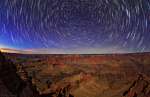 Grand Canyon Star Trails
3.03.2013
One of the natural wonders of planet Earth, the Grand Canyon in the American southwest stretches across this early evening skyscape. The digitally stacked sequence reveals the canyon's layers of sedimentary rock in bright moonlight.
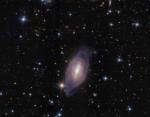 Polar Ring Galaxy NGC 2685
16.02.2007
NGC 2685 is a confirmed polar ring galaxy - a rare type of galaxy with stars, gas and dust orbiting in rings perpendicular to the plane of a flat galactic disk. The bizarre configuration could...
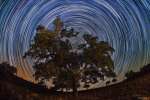 North Celestial Tree
23.10.2013
If you climbed this magnificent tree, it looks like you could reach out and touch the North Celestial Pole at the center of all the star trail arcs. The well-composed image was recorded over a period of nearly 2 hours as a series of 30 second long, consecutive exposures on the night of October 5.
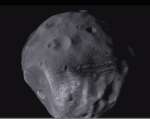 Phobos 360
25.12.2013
What does the Martian moon Phobos look like? To better visualize this unusual object, images from ESA's Mars Express orbiter have been combined into a virtual rotation movie. The rotation is actually a digital illusion -- tidally-locked Phobos always keeps the same face toward its home planet, as does Earth's moon.
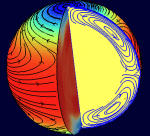 Rivers in the Sun
4.09.1997
The surface of the Sun is shifting. By watching sunspots, it has long been known that our Sun rotates. It was also known that the center of the Sun rotates faster than the poles.
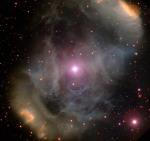 NGC 6164: A Bipolar Emission Nebula
6.06.2006
How did a star form this beautiful nebula? In the middle of emission nebula NGC 6164-5 is an unusually massive star nearing the end of its life. The star, visible in the center...
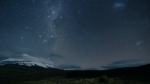 Nocturnal: Scenes from the Southern Night
6.08.2012
Have you ever seen the night sky change? It does -- sometimes in beautiful and unexpected ways. To see it, though, usually requires patience. The above award winning video shows several of the possible changes in dramatic fashion with a time lapse video.
|
January February March April May |
|||||||||||||||||||||||||||||||||||||||||||||||||