
|
You entered: rotation
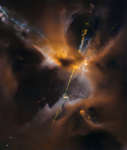 Herbig Haro 24
18.12.2015
This might look like a double-bladed lightsaber, but these two cosmic jets actually beam outward from a newborn star in a galaxy near you. Constructed from Hubble Space Telescope image data, the stunning scene...
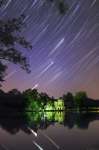 Trails in the Morning Sky
28.07.2012
Brilliant Venus and bright Jupiter still rise together before dawn. The peaceful waters by a small lakeside house near Stuttgart, Germany reflect their graceful arcing trails in this composited series of exposures, recorded on the morning of July 26.
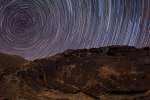 Teimareh Petroglyphs and Star Trails
12.07.2012
Engraved in rock, these ancient petroglyphs are abundant in the Teimareh valley, located in the Zagros Mountains of central Iran. They likely tell a tale of hunters and animals found in the middle eastern valley 6,000 years ago or more, etched by artists in a prehistoric age.
 APOD: 2025 July 20 Б Lunar Nearside
20.07.2025
About 1,300 images from the Lunar Reconnaissance Orbiter spacecraft's wide angle camera were used to compose this spectacular view of a familiar face - the lunar nearside. But why is there a lunar nearside? The Moon rotates on its axis and orbits the Earth at the same rate, about once every 28 days.
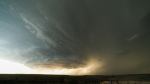 A Supercell Thunderstorm Over Texas
13.06.2021
Is that a cloud or an alien spaceship? It's an unusual and sometimes dangerous type of thunderstorm cloud called a supercell. Supercells may spawn damaging tornados, hail, downbursts of air, or drenching rain. Or they may just look impressive.
 APOD: 2024 May 20 Б Aurora Dome Sky
20.05.2024
It seemed like night, but part of the sky glowed purple. It was the now famous night of May 10, 2024, when people over much of the world reported beautiful aurora-filled skies. The featured image was captured this night during early morning hours from Arlington, Wisconsin, USA.
 Supernova Remnant CTA 1
23.08.2024
There is a quiet pulsar at the heart of CTA 1. The supernova remnant was discovered as a source of emission at radio wavelengths by astronomers in 1960 and since identified as the result of the death explosion of a massive star.
 X Ray Pulsar
23.07.1998
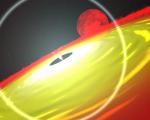
This dramatic artist's vision shows a city-sized neutron star centered in a disk of hot plasma drawn from its enfeebled red companion star. Ravenously accreting material from the disk, the neutron star spins faster and faster emitting powerful particle beams and pulses of X-rays as it rotates 400 times a second.
 Geostationary Highway through Orion
16.01.2017
Put a satellite in a circular orbit about 42,000 kilometers from the center of the Earth and it will orbit once in 24 hours. Because that matches Earth's rotation period, it is known as a geosynchronous orbit.
 Polar Ring Galaxy NGC 660
17.02.2017
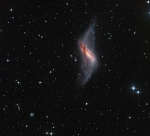
NGC 660 is featured in this cosmic snapshot. Over 40 million light-years away and swimming within the boundaries of the constellation Pisces, NGC 660's peculiar appearance marks it as a polar ring galaxy.
|
January February March April May June July August September |
|||||||||||||||||||||||||||||||||||||||||||||||||