
|
You entered: rotation
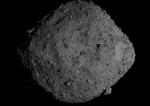 Descending Toward Asteroid Bennu
12.10.2020
What would it be like to land on an asteroid? Although no human has yet done it, NASA's robotic OSIRIS-REx spacecraft is scheduled to attempt to touch the surface of asteroid 101955 Bennu next week.
 APOD: 2025 May 4 Б Spin up of a Supermassive Black Hole
4.05.2025
How fast can a black hole spin? If any object made of regular matter spins too fast -- it breaks apart. But a black hole might not be able to break apart -- and its maximum spin rate is really unknown.
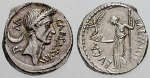 Julius Caesar and Leap Days
29.02.2016
Today, February 29th, is a leap day - a relatively rare occurrence. In 46 BC, Julius Caesar, featured here in a self-decreed minted coin, created a calendar system that added one leap day every four years.
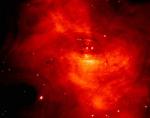 The Pulsar Powered Crab
2.06.2001
In the Summer of 1054 A.D. Chinese astronomers reported that a star in the constellation of Taurus suddenly became as bright as the full Moon. Fading slowly, it remained visible for over a year.
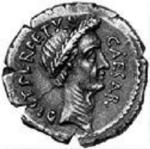 Julius Caesar and Leap Days
29.02.2004
Today, February 29th, is a leap day - a relatively rare occurrence. In 46 BC, Julius Caesar, pictured above in a self-decreed minted coin, created a calendar system that added one leap day every four years.
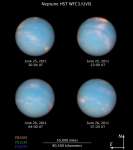 Neptune: Once Around
14.07.2011
Neptune rotates once on its axis in about 16 hours. So, spaced about 4 hours apart these 4 images of the solar system's most distant gas giant cover one Neptune day. Recorded...
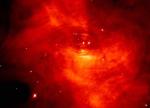 The Pulsar Powered Crab
5.09.1998
In the Summer of 1054 A.D. Chinese astronomers reported that a star in the constellation of Taurus suddenly became as bright as the full Moon. Fading slowly, it remained visible for over a year.
 The Pulsar Powered Crab
31.05.1996
In the Summer of 1054 A.D. Chinese astronomers reported that a star in the constellation of Taurus suddenly became as bright as the full Moon. Fading slowly, it remained visible for over a year.
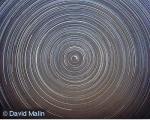 Star Trails in Northern Skies
12.09.1998
As the Earth spins on its axis, the sky seems to rotate around us. This motion produces the beautiful concentric trails traced by the stars in this time exposure of the night sky.
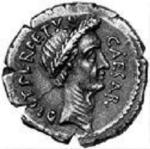 Julius Caesar and Leap Days
29.02.2000
Even as leap days go, today is a remarkable one. In 46 BC, Julius Caesar, pictured above in a self-decreed minted coin, created a calendar system that added one leap day every four years.
|
January February March April May June July August September |
|||||||||||||||||||||||||||||||||||||||||||||||||