
|
You entered: rotation
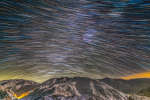 Alborz Mountain Star Trails
2.03.2018
Colourful star trails arc through the night in this wide-angle mountain and skyscape. From a rotating planet, the digitally added consecutive exposures were made with a camera fixed to a tripod and looking south, over northern Iran's Alborz Mountain range.
 Night Trails of Africa
15.11.2002
Spanning southern to northern skies, stars trail across this panoramic view of the African night from equatorial Kenya. The three hour long exposure was made on a clear, dark, mid November evening facing due west and covers just over 180 degrees along the horizon.
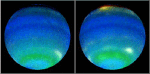 The Weather on Neptune
28.10.1996
Today's weather on Neptune will be typical. Highs in the upper atmosphere will be about -150 Centigrade, with winds ranging about 900 miles per hour near the equator. Much was learned recently about Neptune's weather by the release last week of time-lapse pictures of the most distant gas giant in our Solar System.
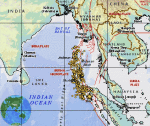 The Powerful Sumatra Andaman Islands Earthquake
2.03.2005
December's 9.0 earthquake has likely shortened Earth's day by about three microseconds and may also have tweaked Earth's rotational wobble. The megathrust earthquake occurred as the Indian tectonic plate slid further beneath the Burma tectonic plate.
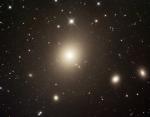 Elliptical Galaxy M87
20.05.2006
In spiral galaxies, majestic winding arms of young stars and interstellar gas and dust rotate in a flat disk around a bulging galactic nucleus. But elliptical galaxies seem to be simpler. Lacking gas and dust to form new stars, their randomly swarming older stars, give them an ellipsoidal (egg-like) shape.
 Movie: Approaching Light Speed
18.10.2011
What would it look like to travel near the speed of light? Strange visual effects would appear as documented in the above relativistically-accurate animation. First of all, relativistic aberration would cause objects to appear to bunch up in front you.
 Yukon Aurora with Star Trails
11.03.2010
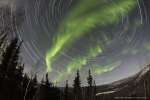
Fixed to a tripod, a camera can record graceful trails traced by stars as planet Earth rotates on its axis. But at high latitudes during March and April, it can also capture an aurora shimmering in the night.
 Earths North Magnetic Pole
18.08.2002
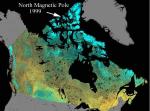
A magnetic compass does not point toward the true North Pole of the Earth. Rather, it more closely points toward the North Magnetic Pole of the Earth. The North Magnetic Pole is currently located in northern Canada.
 An Aurora Cupcake with a Milky Way Topping
9.09.2014
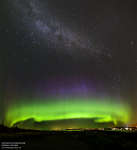
This sky looked delicious. Double auroral ovals were captured above the town lights of жstersund, Sweden, last week. Pictured above, the green ovals occurred lower to the ground than violet aurora rays above, making the whole display look a bit like a cupcake.
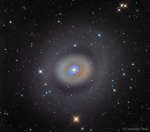 Starburst Galaxy M94
26.05.2015
What could cause the center of M94 to be so bright? Spiral galaxy M94 has a ring of newly formed stars surrounding its nucleus, giving it not only an unusual appearance but also a strong interior glow.
|
January February March April May June July August September |
|||||||||||||||||||||||||||||||||||||||||||||||||