
|
You entered: FUSE
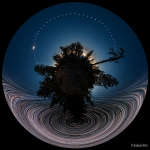 Panoramic Eclipse Composite with Star Trails
30.08.2017
What was happening in the sky during last week's total solar eclipse? This featured little-planet, all-sky, double time-lapse, digitally-fused composite captured celestial action during both night and day from a single location.
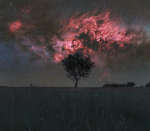 APOD: 2026 March 18 Б Cygnus and the Solitary Tree
18.03.2026
A lone tree stands in a quiet meadow in Guadalajara, Spain, silhouetted against the Cygnus region rising above like flames in the night sky. This deep night skyscape is a composite of exposures that reveals a range of brightness and color human eyes can't quite see on their own.
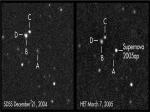 SN 2005ap: The Brightest Supernova Yet Found
16.10.2007
What could cause a bang this big? This supernova explosion was so inherently bright that it could be seen nearby 5 billion light years away (a redshift of 0.28) even with a small telescope.
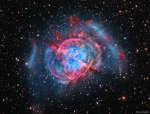 M27: The Dumbbell Nebula
3.12.2019
Is this what will become of our Sun? Quite possibly. The first hint of our Sun's future was discovered inadvertently in 1764. At that time, Charles Messier was compiling a list of diffuse objects not to be confused with comets.
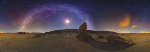 The Milky Way Over Tenerife
5.04.2011
Have you ever seen the band of our Milky Way Galaxy? Chances are you have never seen it like this -- nor could you. In a clear sky from a dark location at the right time, a faint band of light is visible across the sky. This band is the disk of our spiral galaxy.
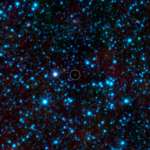 The Coldest Brown Dwarf
30.08.2011
This cosmic snapshot composed with image data from NASA's Wide-field Infrared Survey Explorer (WISE) satellite captures a multitude of faint stars and distant galaxies toward the constellation Lyra at wavelengths longer than visible light. But the object circled at the center is not quite a star.
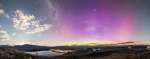 Aurora over New Zealand
26.02.2014
Sometimes the more you look at an image, the more you see. Such may be the case for this beautiful nighttime panorama taken last week in New Zealand. Visible right off, on the far left, are common clouds, slightly altered by the digital fusion of combining 11 separate 20-second exposures.
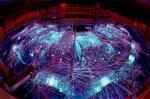 Z Machine Sets Unexpected Earth Temperature Record
13.03.2006
Why is this plasma so hot? Physicists aren't sure. What is known for sure is that the Z Machine running at Sandia National Laboratories created a plasma that was unexpectedly hot. The plasma...
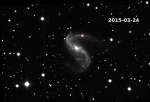 The Rise and Fall of Supernova 2015F
9.02.2016
Sit back and watch a star explode. The actual supernova occurred back when dinosaurs roamed the Earth, but images of the spectacular event began arriving last year. Supernova 2015F was discovered in nearby spiral...
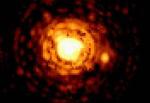 Small Star
5.06.1997
A dim double star system cataloged as Gliese 623 lies 25 light-years from Earth, in the constellation of Hercules. The individual stars of this binary system were distinguished for the first time when the Hubble Space Telescope's Faint Object Camera recorded this image in June 1994.
|
January February March April May June July August |
||||||||||||||||||||||||||||||||||||||||||||||||||||||||