
|
You entered: FUSE
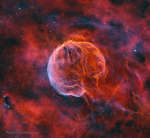 APOD: 2026 January 19 Б CTB 1: The Medulla Nebula
19.01.2026
What powers this unusual nebula? CTB 1 is the expanding gas shell that was left when a massive star toward the constellation of Cassiopeia exploded about 10,000 years ago. The star likely detonated when it ran out of elements, near its core, that could create stabilizing pressure with nuclear fusion.
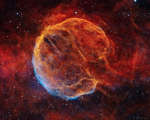 The Medulla Nebula Supernova Remnant
18.01.2021
What powers this unusual nebula? CTB-1 is the expanding gas shell that was left when a massive star toward the constellation of Cassiopeia exploded about 10,000 years ago. The star likely detonated when it ran out of elements, near its core, that could create stabilizing pressure with nuclear fusion.
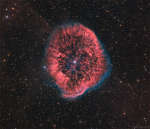 APOD: 2023 February 8 Б Stellar Wind Shaped Nebula RCW 58
8.02.2023
Imagine traveling to a star about 100 times as massive as our Sun, a million times more luminous, and with 30 times the surface temperature. Such stars exist, and some are known as Wolf Rayet (WR) stars, named after French astronomers Charles Wolf and Georges Rayet.
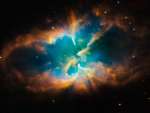 Planetary Nebula NGC 2818
22.01.2009
NGC 2818 is a beautiful planetary nebula, the gaseous shroud of a dying sun-like star. It could well offer a glimpse of the future that awaits our own Sun after spending another 5 billion years or so steadily using up hydrogen at its core, and then finally helium, as fuel for nuclear fusion.
 APOD: 2023 April 24 Б The Medulla Nebula Supernova Remnant
24.04.2023
What powers this unusual nebula? CTB-1 is the expanding gas shell that was left when a massive star toward the constellation of Cassiopeia exploded about 10,000 years ago. The star likely detonated when it ran out of elements near its core that could create stabilizing pressure with nuclear fusion.
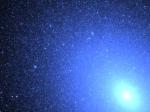 M32: Blue Stars in an Elliptical Galaxy
3.11.1999
Elliptical galaxies are known for their old, red stars. But is this old elliptical up to new tricks? In recent years, the centers of elliptical galaxies have been found to emit unexpectedly high amounts of blue and ultraviolet light.
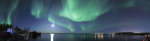 Aurora Over Yellowknife
22.09.2009
Sometimes, after your eyes adapt to the dark, a spectacular sky appears. In this case, a picturesque lake lies in front of you, beautiful green auroras flap high above you, brilliant stars shine far in the distance, and a brilliant moon shines just ahead of you.
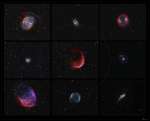 Planetary Nebula Project
18.02.2011
Cast off by dying sunlike stars, planetary nebulae are a brief but glorious final phase of stellar evolution. The gaseous shrouds are ionized by an extremely hot central source, the shrinking core of a star running out of fuel for nuclear fusion.
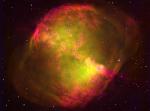 The Dumbbell Nebula in Hydrogen and Oxygen
13.01.2003
The first hint of what will become of our Sun was discovered inadvertently in 1764. At that time, Charles Messier was compiling a list of "annoying" diffuse objects not to be confused with "interesting" comets.
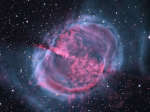 M27: The Dumbbell Nebula
27.12.2011
The first hint of what will become of our Sun was discovered inadvertently in 1764. At that time, Charles Messier was compiling a list of diffuse objects not to be confused with comets.
|
January February |
|||||||||||||||||||||||||||||||||||||||||||||||||