
|
You entered: FUSE
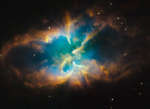 Planetary Nebula NGC 2818 from Hubble
13.07.2014
NGC 2818 is a beautiful planetary nebula, the gaseous shroud of a dying sun-like star. It could well offer a glimpse of the future that awaits our own Sun after spending another 5 billion years or so steadily using up hydrogen at its core, and then finally helium, as fuel for nuclear fusion.
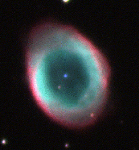 M57: The Ring Nebula
27.07.1995
A star with mass similar to that of our Sun will throw off its outer gasses after fusion has stopped in its core. Possibly the most visually spectacular of these planetary nebula is the pictured Ring Nebula. The appearance as a ring is really an illusion of projection - the nebula is actually a spherical shell.
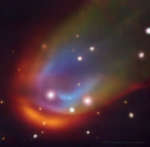 APOD: 2026 February 16 Б Unexplained Shocks Around a White Dwarf Star
16.02.2026
How is RXJ0528+2838 creating such shock waves? A recently discovered white dwarf star, the farther left of the two largest white spots, RXJ0528+2838, was found 730 light-years away from Earth. Most stars...
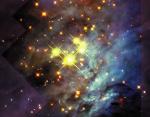 The Brown Dwarfs of Orions Trapezium
30.08.2000
The bright stars above are well known as heart of the Trapezium, an open cluster of stars in the center of the Orion Nebula. The many dim objects, however, are not well known, and have come to attention only on recent images in infrared light.
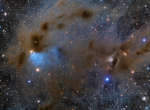 Young Stars and Dusty Nebulae in Taurus
30.03.2017
This complex of dusty nebulae lingers along the edge of the Taurus molecular cloud, a mere 450 light-years distant. Stars are forming on the cosmic scene. Composed from almost 40 hours of image data...
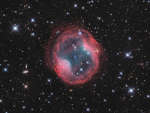 Jones Emberson 1
24.02.2023
Planetary nebula Jones-Emberson 1 is the death shroud of a dying Sun-like star. It lies some 1,600 light-years from Earth toward the sharp-eyed constellation Lynx. About 4 light-years across, the expanding remnant...
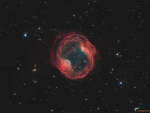 Jones Emberson 1
12.07.2024
Planetary nebula Jones-Emberson 1 is the death shroud of a dying Sun-like star. It lies some 1,600 light-years from Earth toward the sharp-eyed constellation Lynx. About 4 light-years across, the expanding remnant...
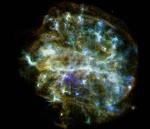 Elements in the Aftermath
26.10.2001
Massive stars spend their brief lives furiously burning nuclear fuel. Through fusion at extreme temperatures and densities surrounding the stellar core, nuclei of light elements like Hydrogen and Helium are combined to heavier elements like Carbon, Oxygen, etc. in a progression which ends with Iron.
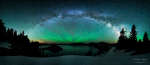 Milky Way Over Crater Lake with Airglow
19.06.2013
How many different astronomical phenomena have come together to create the above vista? Several. First, in the foreground, is Crater Lake -- a caldera created by volcanism on planet Earth about 7,700 years ago. Next, inside the lake, is water.
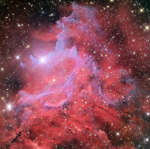 Flaming Star Nebula
1.12.2016
A runaway star lights the Flaming Star Nebula in this cosmic scene. Otherwise known as IC 405, the Flaming Star Nebula's billowing interstellar clouds of gas and dust lie about 1,500 light-years away toward the constellation of Auriga.
|
January February March April May June July August |
||||||||||||||||||||||||||||||||||||||||||||||||||||||||