
|
You entered: FUSE
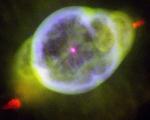 NGC 3242: The Ghost of Jupiter
29.10.2005
After a star like the Sun completes fusion in its core, it throws off its outer layers in a brief, beautiful cosmic display called a planetary nebula. NGC 3242 is such a planetary nebula, with the stellar remnant white dwarf star visible at the center.
 NGC 3242: The 'Ghost of Jupiter' Planetary Nebula
31.03.1997
It's a weed, it's Jupiter, no it's - actually planetary nebula NGC 3242. After a star like our Sun completes fusion in its core, it throws off its outer layers it a striking display called a planetary nebula.
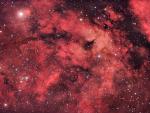 A Cygnus Star Field
28.07.2004
In the constellation of the swan near the nebula of the pelican lies the gas cloud of the butterfly surrounding a star known as the hen. That star, given the proper name Sadr, is visible to the unaided eye but found here as the brightest object on the upper left.
 APOD: 2024 August 27 Б Moon Eclipses Saturn
26.08.2024
What if Saturn disappeared? Sometimes, it does. It doesn't really go away, though, it just disappears from view when our Moon moves in front. Such a Saturnian eclipse, more formally called an occultation, was visible along a long swath of Earth -- from Peru, across the Atlantic Ocean, to Italy -- only a few days ago.
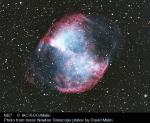 M27: The Dumbbell Nebula
17.02.1998
The first hint of what will become of our Sun was discovered inadvertently in 1764. At that time, Charles Messier was compiling a list of "annoying" diffuse objects not to be confused with "interesting" comets.
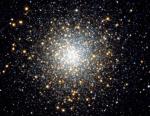 Hydrogen, Helium, and the Stars of M10
30.06.2001
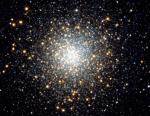
Stars like the Sun use hydrogen for fuel, "burning" hydrogen into helium at their cores through nuclear fusion. But what happens when that hydrogen runs out? For a while, hydrogen burns in a shell surrounding the stellar core and the star expands to become a red giant.
 Dumbbell Nebula Close Up from Hubble
10.02.2003
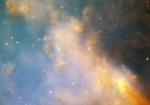
What causes unusual knots of gas and dust in planetary nebulas? Seen previously in the Ring Nebula, the Helix Nebula, and the Eskimo Nebula, the knots' existence was not predicted previously and still not well understood.
 A Supernova in Nearby Galaxy NGC 2403
7.09.2004
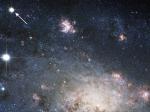
The closest and brightest supernova in over a decade was recorded just over a month ago in the outskirts of nearby galaxy NGC 2403. Officially tagged SN 2004dj, the Type IIP explosion likely annihilated most of a blue supergiant star as central fusion could no longer hold it up.
 Hydrogen, Helium, and the Stars of M10
11.03.1999
Stars like the Sun use hydrogen for fuel, "burning" hydrogen into helium at their cores through nuclear fusion. But what happens when that hydrogen runs out? For a while, hydrogen burns in a shell surrounding the stellar core and the star expands to become a red giant.
 Around the World in 90 Minutes
21.11.2011
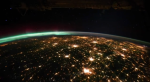
What is it like to circle the Earth? Every 90 minutes, astronauts aboard the International Space Station experience just that. Recently, crew members took a series of light-sensitive videos looking down at night that have been digitally fused to produce the above time-lapse video.
|
January February |
|||||||||||||||||||||||||||||||||||||||||||||||||