
|
You entered: FUSE
 APOD: 2023 March 26 Б Wanderers
26.03.2023
How far out will humanity explore? If this video's fusion of real space imagery and fictional space visualizations is on the right track, then at least the Solar System. Some of the video...
 Nova Cygni 1992
27.12.1995
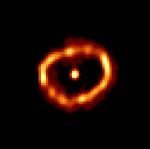
In 1992 a tremendous explosion occurred in the constellation of Cygnus. Dubbed Nova Cygni 1992, this event most probably occurred in an accretion disk binary system. Astronomers hypothesize that this system's white dwarf had so much gas dumped onto it's surface that conditions became ripe for nuclear fusion.
 Comet Holmes Over Hungary
5.12.2007
Comet Holmes refuses to fade. The unusual comet that surprisingly brightened nearly a million-fold in late October continues to remain visible to the unaided eye from dark locations. Night to night, Comet 17P/Holmes is slowly gliding through the constellation Perseus, remaining visible to northern observers during much of the night right from sunset.
 Blue Tears and the Milky Way
24.04.2015
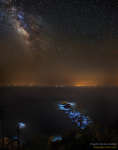
Lapping at rocks along the shore of the Island of Nangan, Taiwan, planet Earth, waves are infused with a subtle blue light in this sea and night skyscape. Composed of a series of long exposures made on April 16 the image captures the faint glow from Noctiluca scintillans.
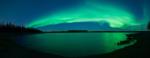 Aurora, Stars, Meteor, Lake, Alaska
9.10.2007
Sometimes, after your eyes adapt to the dark, a spectacular sky appears. In this case, a picturesque lake lies in front of you, beautiful green aurora flap high above you, brilliant stars shine far in the distance, and, for a brief moment, a bright meteor streaks by.
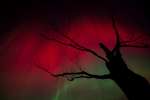 October Skylights
28.10.2011
As northern hemisphere nights grow longer, October is a good month for spotting auroras, or even other eerie apparitions after dark. And this week the night sky did not disappoint. On October 24th a solar coronal mass ejection impacted planet Earth's magnetosphere triggering far ranging auroral displays.
 BZ Cam Bow Shock
28.11.2000
BZ Cam is a binary star system that is not well understood. In most cataclysmic variables, matter from a normal star accumulates on the surface of the companion white dwarf star, eventually causing a nova-like flare as the material becomes hot enough to ignite nuclear fusion.
 Auroras and Star Trails over Iceland
18.05.2015
It was one of the quietest nights of aurora in weeks. Even so, in northern- Iceland during last November, faint auroras lit up the sky every clear night. The featured 360-degree panorama is the digital fusion of four wide-angle cameras each simultaneously taking 101 shots over 42 minutes.
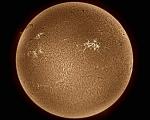 Brown Sun Bubbling
10.01.2000
Our Sun may look like all soft and fluffy, but its not. Our Sun is an extremely large ball of bubbling hot gas, mostly hydrogen gas. The above picture was taken in a specific color of light emitted by hydrogen gas called Hydrogen-alpha.
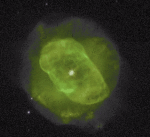 NGC 5882: A Small Planetary Nebula
28.08.1996
Will most stars one day look like this? Pictured above is the planetary nebula NGC 5882, captured by the Hubble Space Telescope. Although planetary nebulae can appear similar to planets like Uranus and Neptune, they are actually gas clouds surrounding stars typically hundreds of light years away.
|
January February March April May June July August September October |
|||||||||||||||||||||||||||||||||||||||||||||||||