
|
You entered: image
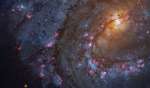 In the Arms of M83
11.11.2011
Big, bright, and beautiful, spiral galaxy M83 lies a mere twelve million light-years away, near the southeastern tip of the very long constellation Hydra. This cosmic close-up, a mosaic based on data from...
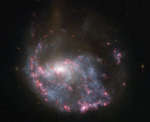 NGC 922: Collisional Ring Galaxy
17.12.2012
Why does this galaxy have so many big black holes? No one is sure. What is sure is that NGC 922 is a ring galaxy created by the collision of a large and small galaxy about 300 million years ago.
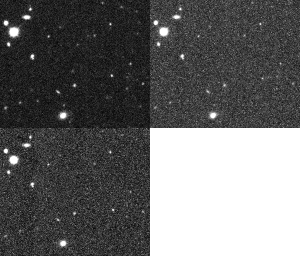 2012 VP113: A New Furthest Known Object in Solar System
31.03.2014
What is the furthest known object in our Solar System? The new answer is 2012 VP113, an object currently over twice the distance of Pluto from the Sun. Pictured above is a series...
 Manhattanhenge: A New York City Sunset
6.07.2014
This coming Saturday, if it is clear, well placed New Yorkers can go outside at sunset and watch their city act like a modern version of Stonehenge. Manhattan's streets will flood dramatically with sunlight just as the Sun sets precisely at each street's western end.
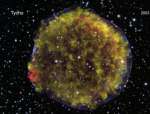 Tychos Supernova Remnant Expands
31.05.2016
What star created this huge expanding puffball? Featured here is the first expansion movie ever created for Tycho's supernova remnant, the result of a stellar explosion first recorded over 400 years ago by the famous astronomer Tycho Brahe.
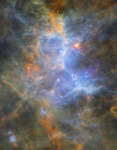 Herschel s Eagle Nebula
27.07.2016
A now famous picture from the Hubble Space Telescope featured Pillars of Creation, star forming columns of cold gas and dust light-years long inside M16, the Eagle Nebula. This false-color composite image views...
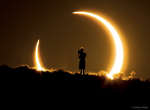 Annular Solar Eclipse over New Mexico
30.08.2016
What is this person doing? In 2012 an annular eclipse of the Sun was visible over a narrow path that crossed the northern Pacific Ocean and several western US states. In an annular solar...
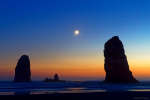 Moon and Venus over Cannon Beach
16.07.2018
What's that spot next to the Moon? Venus. Two days ago, the crescent Moon slowly drifted past Venus, appearing within just two degrees at its closest. This conjunction, though, was just...
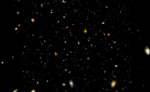 APOD: 2020 July 26 Б A Flight through the Hubble Ultra Deep Field
25.07.2020
What would it look like to fly through the distant universe? To find out, a team of astronomers estimated the relative distances to over 5,000 galaxies in one of the most distant fields of galaxies ever imaged: the Hubble Ultra Deep Field (HUDF).
 Hale-Bopp: The Great Comet of 1997
7.04.2022
Only twenty-five years ago, Comet Hale-Bopp rounded the Sun and offered a dazzling spectacle in planet Earth's night skies. Digitized from the original astrophoto on 35mm color slide film, this classic image of the Great Comet of 1997 was recorded a few days after its perihelion passage on April 1, 1997.
|
January February March April May June July August September |
|||||||||||||||||||||||||||||||||||||||||||||||||