
|
You entered: image
 Sharpless 308: The Dolphin Head Nebula
7.06.2024
Blown by fast winds from a hot, massive star, this cosmic bubble is huge. Cataloged as Sharpless 2-308 it lies some 5,000 light-years away toward the well-trained constellation Canis Major and covers slightly more of the sky than a Full Moon. That corresponds to a diameter of 60 light-years at its estimated distance.
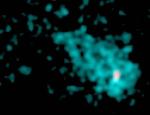 IC443's Neutron Star
15.12.2000
Using x-ray data from the orbiting Chandra Observatory along with radio data from the Very Large Array, a team of researchers has discovered evidence for a new example of one of the most bizarre objects known to modern astrophysics -- a neutron star.
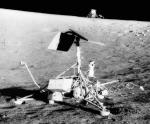 Apollo 12: Surveyor 3 and Intrepid
8.04.1999
On April 20, 1967, NASA's robot spacecraft Surveyor 3 landed on the moon, touching down on the inside slope of a small lunar crater in the Ocean of Storms. Over 2 1/2 years...
 Mir Dreams
26.08.2000
This dream-like image of Mir was recorded by astronauts as the Space Shuttle Atlantis approached the Russian space station prior to docking during the STS-76 mission. Sporting spindly appendages and solar panels...
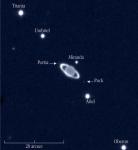 Ringed Planet Uranus
15.01.2003
Yes it does look like Saturn, but Saturn is one of only four giant ringed planets in our Solar System. And while Saturn has the brightest rings, this system of rings and moons actually belongs to planet Uranus, imaged here in near-infrared light by the Antu telescope at the ESO Parnal Observatory in Chile.
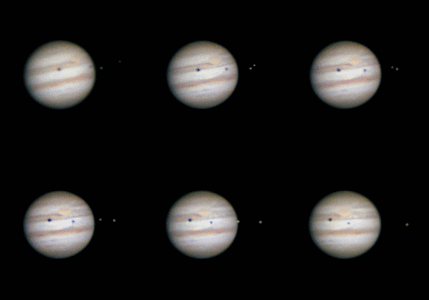 When Moons and Shadows Dance
27.02.2003
It's no wonder Jupiter is a favorite target for even modest earthbound telescopes. The most massive planet in the solar system with four of the largest moons also boasts the famous Great Red Spot, a giant hurricane-like storm system over three hundred years old.
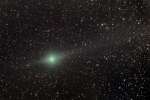 Comet Lulin Approaches
2.02.2009
How bright will Comet Lulin become? No one knows for sure. Although it is notoriously difficult to accurately predict the brightness of newly discovered comets, Comet Lulin could well become visible to the unaided eye later this month.
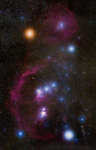 Camera Orion
21.03.2018
Do you recognize this constellation? Although it is one of the most recognizable star groupings on the sky, Orion's icons don't look quite as colorful to the eye as they do to a camera.
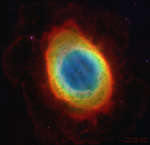 M57: The Ring Nebula from Hubble
17.08.2021
Except for the rings of Saturn, the Ring Nebula (M57) is probably the most famous celestial circle. Its classic appearance is understood to be due to our own perspective, though. The recent mapping...
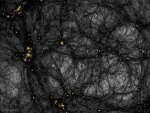 Dark Matter in a Simulated Universe
31.10.2021
Is our universe haunted? It might look that way on this dark matter map. The gravity of unseen dark matter is the leading explanation for why galaxies rotate so fast, why galaxies orbit clusters...
|
January February March April May June July August September |
|||||||||||||||||||||||||||||||||||||||||||||||||