
|
You entered: image
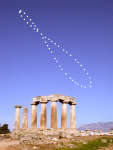 Apollo s Analemma
22.09.2013
Today, the Sun crosses the celestial equator heading south at 20:44 Universal Time. An equinox (equal night), this astronomical event marks the first day of autumn in the northern hemisphere and spring in the south.
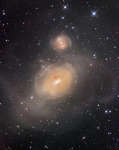 NGC 1316: After Galaxies Collide
2.02.2017
An example of violence on a cosmic scale, enormous elliptical galaxy NGC 1316 lies about 75 million light-years away toward Fornax, the southern constellation of the Furnace. Investigating the startling sight, astronomers suspect the giant galaxy of colliding with smaller neighbor NGC 1317 seen just above, causing far flung loops and shells of stars.
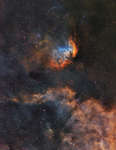 The Tulip and Cygnus X 1
29.07.2021
This tall telescopic field of view looks out along the plane of our Milky Way Galaxy toward the nebula rich constellation Cygnus the Swan. Popularly called the Tulip Nebula, the brightest glowing cloud of interstellar gas and dust above center is also found in the 1959 catalog by astronomer Stewart Sharpless as Sh2-101.
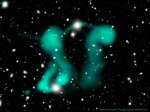 Dancing Ghosts: Curved Jets from Active Galaxies
1.09.2021
Why would galaxies emit jets that look like ghosts? And furthermore, why do they appear to be dancing? The curled and fluffy jets from the supermassive black holes at the centers of two host galaxies (top center and lower left) are unlike anything seen before.
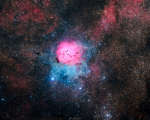 A Beautiful Trifid
5.08.2022
The beautiful Trifid Nebula is a cosmic study in contrasts. Also known as M20, it lies about 5,000 light-years away toward the nebula rich constellation Sagittarius. A star forming region in the plane...
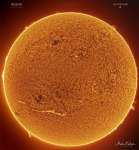 APOD: 2023 February 22 Б Our Increasingly Active Sun
22.02.2023
Our Sun is becoming a busy place. Only two years ago, the Sun was emerging from a solar minimum so quiet that months would go by without even a single sunspot. In contrast, already...
 APOD: 2023 September 9 Б Comet Nishimura Grows
9.09.2023
Comet Nishimura is growing. More precisely, the tails C/2023 P1 (Nishimura) are growing as it nears the Sun. Discovered only last month, the comet is already near naked eye brightness as it now moves inside the Earth's orbit.
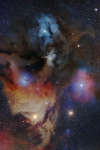 APOD: 2026 July 1 Б The Cotton Candy Clouds of Rho Ophiuchi
1.07.2026
Although they look like cotton candy, you cannot eat these clouds! Taken in Cádiz, Spain, today's image features the Rho Ophiuchi complex, a rich tapestry of young and old astronomical phenomena. This colorful cloud complex is a nearby star-forming region containing hundreds of young stellar objects, including protostars and T Tauri stars.
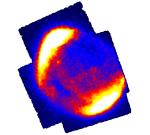 SN 1006: Pieces of the Cosmic Ray Puzzle
16.10.1996
Research balloon flights conducted in 1912 by Austrian physicist Victor Hess revealed that the Earth was constantly bombarded by high energy radiation from space - which came to be called "Cosmic Rays". What are Cosmic Rays and where do they come from?
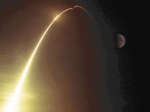 Destination: Moon
8.01.1998
Tuesday, January 6, at 9:28 p.m. EST, NASA's Lunar Prospector spacecraft climbed into the sky above Cape Canaveral Air Station riding an Athena II rocket. Representing NASA's first Moon mission since...
|
January February March April May June July August September |
|||||||||||||||||||||||||||||||||||||||||||||||||