
|
You entered: image
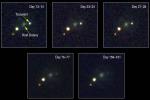 Gamma Ray Burst, Supernova Bump
17.05.2002
On the 21st of November 2001, satellites detected yet another burst of gamma-rays from the cosmos. While this flash of high-energy photons lasted for less than a minute, eager astronomers have been following the fading optical light from the location of the burst source ever since.
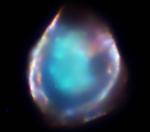 DEM L71: When Small Stars Explode
14.03.2003
Large, massive stars end their furious lives in spectacular supernova explosions -- but small, low mass stars may encounter a similar fate. In fact, instead of simply cooling off and quietly fading away, some white...
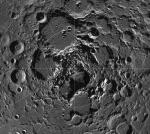 Water Ice At The Lunar Poles
6.03.1998
After seven weeks in lunar orbit, instruments on board NASA's Lunar Prospector spacecraft have produced strong evidence for water ice on the Moon. While not in extensive sheets, this ice could be in the form of crystals, mixed in low concentrations with material in craters around the frigid North and South lunar poles.
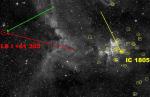 Microquasar in Motion
16.09.2004
Microquasars, bizarre binary star systems, generating high-energy radiation and blasting out jets of particles at nearly the speed of light, live in our Milky Way galaxy. The energetic microquasar systems seem to consist...
 Landing At The Martian South Pole
1.12.1999
The latest invader from Earth, the Mars Polar Lander (MPL) spacecraft, is scheduled to touch down on the Red Planet's surface on Friday, December 3rd. If all goes well the robotic explorer will...
 International Space Station: Find the Astronaut
2.12.2008
Where's the astronaut? Somewhere in this impressive array of International Space Station (ISS) hardware, astronaut Steve Bowen can be found upgrading and cleaning key parts of Earth's most prominent orbital outpost. Astronaut...
 Messier 106
29.05.2009
Close to the Great Bear (Ursa Major) and surrounded by the stars of the Hunting Dogs (Canes Venatici), this celestial wonder was discovered in 1781 by the metric French astronomer Pierre Mechain. Later, it was added to the catalog of his friend and colleague Charles Messier as M106.
 Geostationary Highway
20.02.2010
Put a satellite in a circular orbit about 42,000 kilometers from the center of the Earth (36,000 kilometers or so above the surface) and it will orbit once in 24 hours. Because that matches Earth's rotation period, it is known as a geosynchronous orbit.
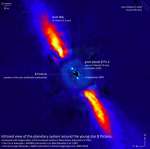 A Giant Planet for Beta Pic
3.07.2010
A mere 50 light-years away, young star Beta Pictoris became one of the most important stars in the sky in the early 1980s. Satellite and ground-based telescopic observations revealed the presence of a surrounding...
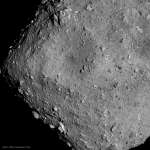 Asteroid Ryugu from Hayabusa2
22.08.2018
This big space diamond has an estimated value of over 80 billion dollars. It's only diamond in shape, though -- asteroid 162173 Ryugu is thought to be composed of mostly nickel and iron. Asteroids...
|
January February March April May June July August September |
|||||||||||||||||||||||||||||||||||||||||||||||||