
|
You entered: image
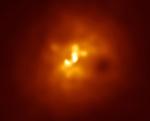 Abell 2597 s Cosmic Cavities
16.01.2002
Typical of large galaxy clusters billions of light-years away, Abell 2597 features hundreds of galaxies embedded in a cloud of multimillion degree gas which glows in x-rays. This Chandra Observatory x-ray image shows...
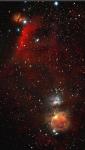 Orion Nebulosities
30.05.2002
Adrift 1,500 light-years away in one of the night sky's most recognizable constellations, the glowing Orion Nebula and the dark Horsehead Nebula are contrasting cosmic vistas. They both appear in this stunning composite color photograph along with other nebulosities as part of the giant Orion Molecular Cloud complex, itself hundreds of light-years across.
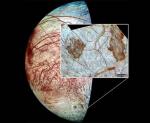 Galileo s Europa
19.09.2003
Launched in 1989 and looping through the jovian system since late 1995, the voyage of NASA's Galileo spacecraft will soon come to an end. The spacecraft has been targeted to plunge directly into Jupiter this Sunday, September 21st, at about 30 miles per second.
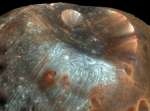 Stickney Crater
7.11.2009
Stickney Crater, the largest crater on the martian moon Phobos, is named for Chloe Angeline Stickney Hall, mathematician and wife of astronomer Asaph Hall. Asaph Hall discovered both the Red Planet's moons in 1877.
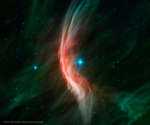 Zeta Oph: Runaway Star
5.07.2015
Like a ship plowing through cosmic seas, runaway star Zeta Ophiuchi produces the arcing interstellar bow wave or bow shock seen in this stunning infrared portrait. In the false-color view, bluish Zeta...
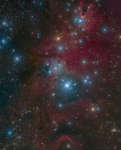 Fox Fur, a Unicorn, and a Christmas Tree
24.12.2016
Clouds of glowing hydrogen gas fill this colorful skyscape in the faint but fanciful constellation Monoceros, the Unicorn. A star forming region cataloged as NGC 2264, the complex jumble of cosmic gas and dust...
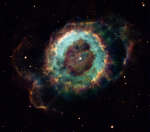 NGC 6369: The Little Ghost Nebula
28.10.2017
Wraithlike NGC 6369 is a faint apparition in night skies popularly known as the Little Ghost Nebula. It was discovered by 18th century astronomer Sir William Herschel as he used a telescope to explore the medicinal constellation Ophiucus. Herschel historically classified the round and planet-shaped nebula as a Planetary Nebula.
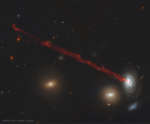 The Long Gas Tail of Spiral Galaxy D100
28.01.2019
Why is there long red streak attached to this galaxy? The streak is made mostly of glowing hydrogen that has been systematically stripped away as the galaxy moved through the ambient hot gas in a cluster of galaxies. Specifically, the galaxy is spiral galaxy D100, and cluster is the Coma Cluster of galaxies.
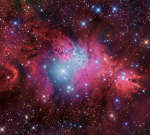 Fox Fur, Unicorn, and Christmas Tree
7.02.2019
Clouds of glowing hydrogen gas fill this colorful skyscape in the faint but fanciful constellation Monoceros, the Unicorn. A star forming region cataloged as NGC 2264, the complex jumble of cosmic gas and dust...
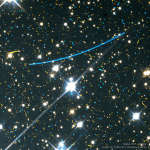 Asteroids in the Distance
31.01.2021
Rocks from space hit Earth every day. The larger the rock, though, the less often Earth is struck. Many kilograms of space dust pitter to Earth daily. Larger bits appear initially as a bright meteor. Baseball-sized rocks and ice-balls streak through our atmosphere daily, most evaporating quickly to nothing.
|
January February March April May June July August September |
|||||||||||||||||||||||||||||||||||||||||||||||||