
|
You entered: image
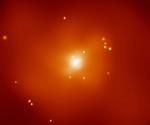 Dark Matter, X rays, and NGC 720
26.10.2002
Elliptical galaxy NGC 720 is enveloped in a cosmic cloud of x-ray emitting gas. Seen in this false color image from the Chandra X-ray Observatory, the extreme temperature of the gas - about 7 million...
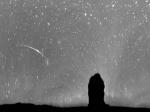 A Taurid Meteor Fireball
14.11.2005
Have you ever seen a very bright meteor? Unexpected, this year's Taurid meteor shower resulted in numerous reports of very bright fireballs during the nights surrounding Halloween. Pictured above, a fireball that momentarily rivaled the brightness of the full Moon was caught over Cerro Pachon, Chile by a continuous sky monitor on November 1.
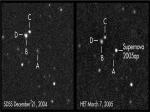 SN 2005ap: The Brightest Supernova Yet Found
16.10.2007
What could cause a bang this big? This supernova explosion was so inherently bright that it could be seen nearby 5 billion light years away (a redshift of 0.28) even with a small telescope.
 Comet and Orion
2.10.2009
These colorful panels both feature a familiar northern hemisphere astronomical sight: the stellar nursery known as the Great Orion Nebula. They also offer an intriguing and unfamiliar detail of the nebula rich skyscape -- a passing comet.
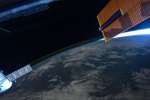 Perseid Below
17.08.2011
Denizens of planet Earth watched this year's Perseid meteor shower by looking up into the moonlit night sky. But this remarkable view captured by astronaut Ron Garan looks down on a Perseid meteor.
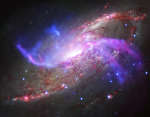 M106 Across the Spectrum
5.07.2014
The spiral arms of bright, active galaxy M106 sprawl through this remarkable multiwavelength portrait, composed of image data from radio to X-rays, across the electromagnetic spectrum. Also known as NGC 4258, M106 can be found toward the northern constellation Canes Venatici.
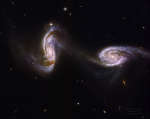 Arp 240: A Bridge between Spiral Galaxies from Hubble
27.11.2016
Why is there a bridge between these two spiral galaxies? Made of gas and stars, the bridge provides strong evidence that these two immense star systems have passed close to each other and experienced violent tides induced by mutual gravity.
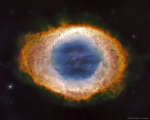 M57: The Ring Nebula
16.04.2018
Except for the rings of Saturn, the Ring Nebula (M57) is probably the most famous celestial band. Its classic appearance is understood to be due to our own perspective, though. The recent mapping...
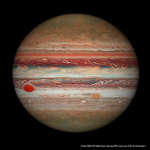 Hubbles Jupiter and the Shrinking Great Red Spot
24.04.2018
What will become of Jupiter's Great Red Spot? Gas giant Jupiter is the solar system's largest world with about 320 times the mass of planet Earth. Jupiter is home to one of the largest and longest lasting storm systems known, the Great Red Spot (GRS), visible to the left.
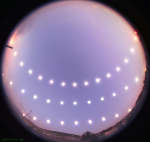 Equinox: The Sun from Solstice to Solstice
22.09.2019
Today is an equinox, a date when day and night are equal. Tomorrow, and every day until the next equinox, the night will be longer than the day in Earth's northern hemisphere, and the day will be longer than the night in Earth's southern hemisphere.
|
January February March April May June July August September |
|||||||||||||||||||||||||||||||||||||||||||||||||