
|
You entered: image
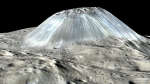 Unusual Mountain Ahuna Mons on Asteroid Ceres
9.10.2017
What created this unusual mountain? Ahuna Mons is the largest mountain on the largest known asteroid in our Solar System, Ceres, which orbits our Sun in the main asteroid belt between Mars and Jupiter. Ahuna Mons, though, is like nothing that humanity has ever seen before.
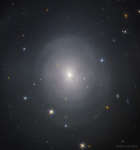 NGC 4993: The Galactic Home of an Historic Explosion
23.10.2017
That reddish dot -- it wasn't there before. It's the dot to the upper left of galaxy NGC 4993's center, do you see it? When scanning the large field of possible locations...
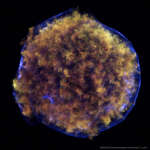 Tychos Supernova Remnant in Xray
13.01.2019
What star created this huge puffball? What's pictured is the hot expanding nebula of Tycho's supernova remnant, the result of a stellar explosion first recorded over 400 years ago by the famous astronomer Tycho Brahe. The featured image is a composite of three X-ray colors taken by the orbiting Chandra X-ray Observatory.
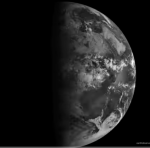 Equinox on Planet Earth
20.03.2019
Welcome to an equinox on planet Earth. Today is the first day of spring in our fair planet's northern hemisphere, fall in the southern hemisphere, with day and night nearly equal around the globe.
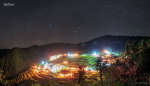 Dark Skies: Turn on the Night
16.05.2019
Have you ever experienced a really dark night sky? One common and amazing feature is the glowing band of our Milky Way galaxy stretching from horizon to horizon. If you live in or near...
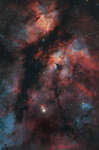 The Gamma Cygni Nebula
18.06.2022
Supergiant star Gamma Cygni is at the center of the Northern Cross. Near the plane of our Milky Way galaxy, that famous asterism flies high in northern summer night skies in the constellation Cygnus the Swan.
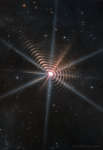 Dust Shells around WR 140 from Webb
13.10.2022
What are those strange rings? Rich in dust, the rings are likely 3D shells -- but how they were created remains a topic of research. Where they were created is well known: in a binary...
 APOD: 2025 March 12 Б NGC 772: The Fiddlehead Galaxy
12.03.2025
Why does this galaxy look like a curly vegetable? The Fiddlehead spiral galaxy likely gets its distorted spiral appearance from a gravitational interaction with its close-by elliptical companion NGC 770, seen just below. Cataloged...
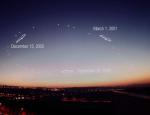 Venus Evening Loop
1.06.2001
From September 2000 through March 2001, astronomer Tunc Tezel patiently photographed the planet Venus on 25 different dates as it wandered through the evening twilight. The pictures were taken from the same spot...
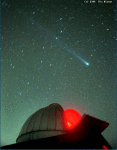 Hyakutake, Big Dipper, and Observatory Dome
1.04.1996
In one of the more spectacular pictures yet taken, Comet Hyakutake is shown here on March 26 high in the dark Missouri sky. In the foreground is Elmcrest Observatory complete with a dim red light glowing inside the dome.
|
January February March April May June July August September |
|||||||||||||||||||||||||||||||||||||||||||||||||