
|
You entered: image
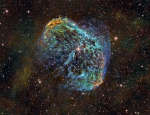 NGC 6888: The Crescent Nebula
16.08.2012
NGC 6888, also known as the Crescent Nebula, is a cosmic bubble about 25 light-years across, blown by winds from its central, bright, massive star. This colorful portrait of the nebula uses narrow band image data combined in the Hubble palatte.
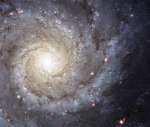 M74: The Perfect Spiral
11.08.2013
If not perfect, then this spiral galaxy is at least one of the most photogenic. An island universe of about 100 billion stars, 32 million light-years away toward the constellation Pisces, M74 presents a gorgeous face-on view.
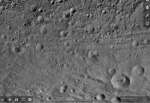 Vesta Trek: A Digital Model of Asteroid Vesta
21.04.2015
You can explore asteroid Vesta. Recently, NASA's robotic spaceship Dawn visited Vesta, the second largest object in our Solar System's main asteroid belt, which lies between Mars and Jupiter. During a year-long stopover, Dawn's cameras photographed Vesta's entire surface, documenting all of the minor planet's major mountains and craters.
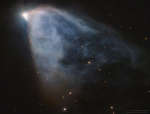 NGC 2261: Hubble s Variable Nebula
8.11.2017
What causes Hubble's Variable Nebula to vary? The unusual nebula featured here changes its appearance noticeably in just a few weeks. Discovered over 200 years ago and subsequently cataloged as NGC 2661, the remarkable nebula is named for Edwin Hubble, who studied it early last century.
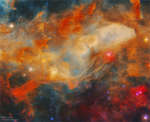 The Blue Horsehead Nebula in Infrared
23.04.2018
The Blue Horsehead Nebula looks quite different in infrared light. In visible light, the reflecting dust of the nebula appears blue and shaped like a horse's head. In infrared light, however, a complex labyrinth of filaments, caverns, and cocoons of glowing dust and gas emerges, making it hard to even identify the equine icon.
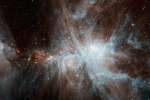 Spitzer's Orion
31.08.2019
Few cosmic vistas excite the imagination like the Orion Nebula, an immense stellar nursery some 1,500 light-years away. Spanning about 40 light-years across the region, this infrared image from the Spitzer Space Telescope...
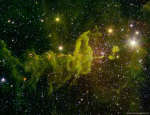 The Spider Nebula in Infrared
4.09.2019
Will the spider ever catch the fly? Not if both are large emission nebulas toward the constellation of the Charioteer (Auriga). The spider-shaped gas cloud on the left is actually an emission nebula labelled...
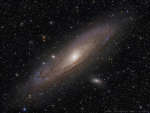 Andromeda Island Universe
30.04.2020
The most distant object easily visible to the unaided eye is M31, the great Andromeda Galaxy some two and a half million light-years away. But without a telescope, even this immense spiral galaxy - spanning over 200,000 light years - appears as a faint, nebulous cloud in the constellation Andromeda.
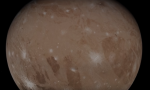 Juno Flyby of Ganymede and Jupiter
11.10.2021
What would it be like to fly over the largest moon in the Solar System? In June, the robotic Juno spacecraft flew past Jupiter's huge moon Ganymede and took images that have been digitally constructed into a detailed flyby.
 APOD: 2024 February 27 Б Supernova Remnant Simeis 147
27.02.2024
It's easy to get lost following the intricate, looping, and twisting filaments of supernova remnant Simeis 147. Also cataloged as Sharpless 2-240, the filamentary nebula goes by the popular nickname the Spaghetti Nebula.
|
January February March April May June July August September |
|||||||||||||||||||||||||||||||||||||||||||||||||