
|
You entered: image
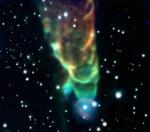 Cosmic Tornado HH 49 50
11.08.2007
Light-years in length, this cosmic tornado is actually a powerful jet cataloged as HH (Herbig-Haro) 49/50 blasting down from the top of a Spitzer Space Telescope view. Though such energetic outflows are well known...
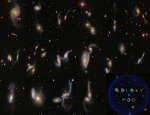 Galaxy Zoo Catalogs the Universe
26.10.2009
You, too, can Zoo. The Galaxy Zoo project has been enabling citizen scientists -- inquisitive people like yourself armed with only a web browser-- to sort through the universe. Specifically, after a brief training session...
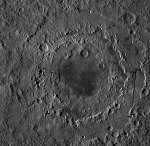 Mare Orientale
12.03.2011
Shaped like a target ring bull's-eye, the Mare Orientale is one of the most striking large scale lunar features. Located on the Moon's extreme western edge, it is unfortunately difficult to see from an earthbound perspective.
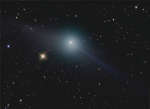 The Opposing Tails of Comet Garradd
28.02.2012
Why does Comet Garradd have two tails? Visible on the left, Comet Garradd's dust tail is composed of ice and dust bits that trial the comet in its orbit around the Sun. Visible...
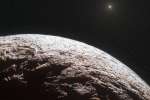 Makemake of the Outer Solar System
26.12.2012
Makemake is one of the largest objects known in the outer Solar System. Pronounced MAH-kay MAH-kay, this Kuiper belt object is about two-thirds the size of Pluto, orbits the Sun only slightly further out than Pluto, and appears only slightly dimmer than Pluto.
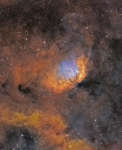 The Tulip in the Swan
14.11.2014
Framing a bright emission region this telescopic view looks out along the plane of our Milky Way Galaxy toward the nebula rich constellation Cygnus the Swan. Popularly called the Tulip Nebula the glowing cloud of interstellar gas and dust is also found in the 1959 catalog by astronomer Stewart Sharpless as Sh2-101.
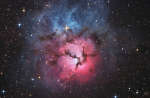 A Beautiful Trifid
20.10.2017
The beautiful Trifid Nebula is a cosmic study in contrasts. Also known as M20, it lies about 5,000 light-years away toward the nebula rich constellation Sagittarius. A star forming region in the plane...
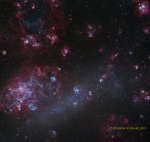 Clouds in the LMC
19.01.2018
An alluring sight in southern skies, the Large Magellanic Cloud (LMC) is seen in this deep and detailed telescopic mosaic. Recorded with broadband and narrowband filters, the scene spans some 5 degrees or 10 full moons. The narrowband filters are designed to transmit only light emitted by hydrogen, and oxygen atoms.
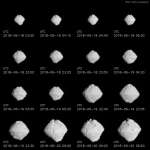 Hayabusa2 Approaches Asteroid Ryugu
25.06.2018
It looks like a big space diamond -- but with craters. It's 162173 Ryugu (Dragon's Castle), and Japan's robotic Hayabusa2 mission is now arriving at this near-Earth asteroid. Ambitious Hayabusa2 is carrying...
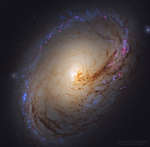 Spiral Galaxy M96 from Hubble
12.06.2019
Dust lanes seem to swirl around the core of Messier 96 in this colorful, detailed portrait of the center of a beautiful island universe. Of course M96 is a spiral galaxy, and counting...
|
January February March April May June July August September |
|||||||||||||||||||||||||||||||||||||||||||||||||