
|
You entered: image
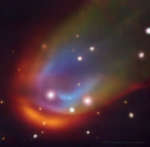 APOD: 2026 February 16 Б Unexplained Shocks Around a White Dwarf Star
16.02.2026
How is RXJ0528+2838 creating such shock waves? A recently discovered white dwarf star, the farther left of the two largest white spots, RXJ0528+2838, was found 730 light-years away from Earth. Most stars...
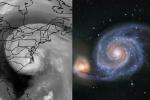 Logarithmic Spirals Isabel and M51
25.09.2003
Uncomfortably close hurricane Isabel (left) and 30 million light-year distant galaxy M51 actually don't have much in common. For starters, Isabel was hundreds of miles across, while M51 (the Whirlpool Galaxy) spans about...
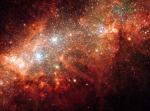 NGC 1569: Starburst in a Small Galaxy
5.02.2004
Grand spiral galaxies often seem to get all the glory, flaunting their young, bright, blue star clusters in beautiful, symmetric spiral arms. But small, irregular galaxies form stars too. In fact, as pictured here...
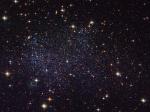 Sagittarius Dwarf Irregular Galaxy
16.11.2004
How old is this galaxy? The nearby Local Group galaxy dubbed the Sagittarius Dwarf Irregular Galaxy (SagDIG) is not only very small but also has relatively few elements more massive than helium.
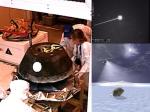 Stardust Capsule Returns to Earth
16.01.2006
A flying saucer from outer space crash-landed in the Utah desert yesterday after being tracked by radar and chased by helicopters and airplanes. Like last time, no space aliens were involved. The saucer...
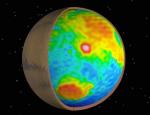 Inside Mars
23.03.2000
What's inside Mars? From orbit, the Mars Global Surveyor (MGS) spacecraft has recorded detailed images of the red planet since July 1997. Still, its cameras can not look beneath the surface. But minute...
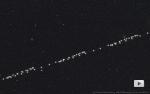 Three Years of Saturn
7.04.2007
Using an image recorded just last month as a base, this composite illustration tracks the motion of bright Saturn as it wanders through planet Earth's night sky. Starting at the upper right, Saturn's position is shown about every two weeks beginning in August 2005 and projected through September 2008.
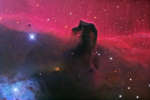 The Horsehead Nebula in Orion
26.11.2008
One of the most identifiable nebulae in the sky, the Horsehead Nebula in Orion, is part of a large, dark, molecular cloud. Also known as Barnard 33, the unusual shape was first discovered on a photographic plate in the late 1800s.
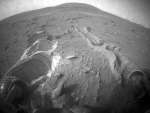 Spirit Encounters Soft Ground on Mars
1.06.2009
Will Spirit be able to free itself from soft ground on Mars? The robotic Spirit rover currently rolling across Mars ran into unexpectedly soft ground last month while exploring the red planet. A worry...
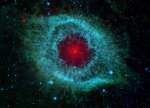 Dust and the Helix Nebula
31.12.2009
Dust makes this cosmic eye look red. The eerie Spitzer Space Telescope image shows infrared radiation from the well-studied Helix Nebula (NGC 7293) a mere 700 light-years away in the constellation Aquarius.
|
January February March April May June July August September |
|||||||||||||||||||||||||||||||||||||||||||||||||